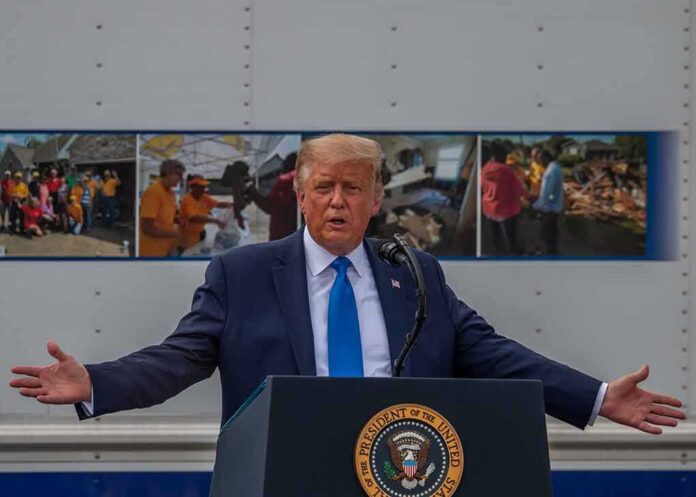
President Trump rejected Iran’s seven-day Strait of Hormuz plan, refusing sanctions relief, blockade lifts, and ceasefire demands tied to reopening the vital waterway.
Story Snapshot
- Trump said “I reject their proposal,” dismissing Iran’s seven-day conditions package.
- Iran’s offer linked reopening the strait to U.S. sanctions relief and lifting a naval blockade.
- Trump said the United States had “total control” and that ships continued to move through the strait.
- Roughly 80 nations at the United Nations pressed for reopening and condemned attacks on shipping.
Trump’s On-Record Rejection at the White House
President Trump said at the White House that he rejected Iran’s proposal to reopen the Strait of Hormuz. He used clear language, saying “I reject their proposal” and “I rejected their deal.” Reuters tied his remarks to active talks around the United Nations General Assembly and Qatari mediation. That detail shows the statement was part of live diplomacy, not rumor or spin, according to the reporting on the exchange.
The Associated Press captured Trump’s public claim of leverage on the waterway. He said the United States had “total control of the Haros Strait,” a phrasing linked to the Strait of Hormuz in the same remarks. He also pointed to ship movements, saying “last night we had 29 ships come out,” to argue oil was moving despite Iranian pressure. Those claims came without published logs or formal orders in the available reports.
What Tehran Wanted in the Seven-Day Package
Iran’s message said it would reopen the Strait within seven days if the United States met several conditions. Reuters reported those conditions included easing military pressure, lifting a naval blockade of Iranian ports, sanctions relief on oil sales, and steps linked to a broader ceasefire in the region. The offer connected reopening the strait to restarting nuclear talks after the seven-day period, according to the same reporting.
Iran’s timeline hinged on U.S. acceptance. Public statements from Iranian officials said the seven-day clock would start only after Washington agreed to the package. That sequence placed reopening at the end of the week, not day one. The structure shows Iran treated the strait as a bargaining chip inside a larger deal, not as a goodwill step offered up front, based on the available summaries.
Allies, Energy Security, and Why the U.S. Said No
International partners pressed for stability while rejecting attacks on shipping. Reuters reported that around 80 countries at the United Nations demanded the urgent reopening of the Strait of Hormuz and condemned actions by Iran and the Houthis that disrupted global trade and energy security. That chorus raised the political cost of delay and signaled that the world expected safe passage to resume soon.
U.S. officials have long said they would not agree to Iranian control over access to the strait. Reuters reported in August that the United States rejected any deal that handed Tehran a gatekeeper role over the world’s key energy route. That red line helps explain Trump’s refusal to trade sanctions relief and a blockade lift for a timed reopening that Tehran would still claim to manage.
What Is Proven, What Needs Documents, and What It Means for Americans
The record firmly shows Trump’s rejection and Iran’s conditions-based, seven-day plan. The reporting does not include a released, signed text of the Iranian proposal. It also does not publish U.S. naval orders or shipping logs that would prove “total control” or the exact ship count Trump cited. Those limits do not change the core fact pattern: Iran sought relief first; the United States refused to pay to reopen an international strait.
ENERGY: The strait is now part of the negotiation.
Iran says reopening Hormuz depends on agreed conditions, after Trump rejected its proposal to reopen the waterway and end the fighting, Reuters reported on 27 September. Shipping through the route has already fallen sharply, and… pic.twitter.com/OJ5fDfHBN6
— The Flow Insight (@theflowinsight) September 27, 2026
For American families, the stakes are clear. Energy costs rise when rogue actors threaten a choke point. The United States cannot reward coercion that ties free passage to ransom-like demands. Conservative policy supports strength, lawful transit, and no special favors for regimes that menace global trade. The administration’s stance aligns with that view: keep pressure on Tehran, protect shipping, and do not trade away U.S. leverage or security to buy a one-week promise that Tehran could try to rewrite later.
Sources:
youtube.com, reuters.com, investing.com, iranintl.com