Pulling U.S. forces back to the Second Island Chain would weaken deterrence and rattle key allies who anchor freedom in the Western Pacific.
Story Highlights
- The 2026 defense strategy centers on denying aggression along the First Island Chain.
- Pentagon leaders link resilient forward bases and allied support to deterrence by denial.
- Admiral Davidson backs a distributed force that can fight across both island chains.
- China is building options to coerce Taiwan and project power deeper into the Pacific.
What Washington’s Strategy Actually Says
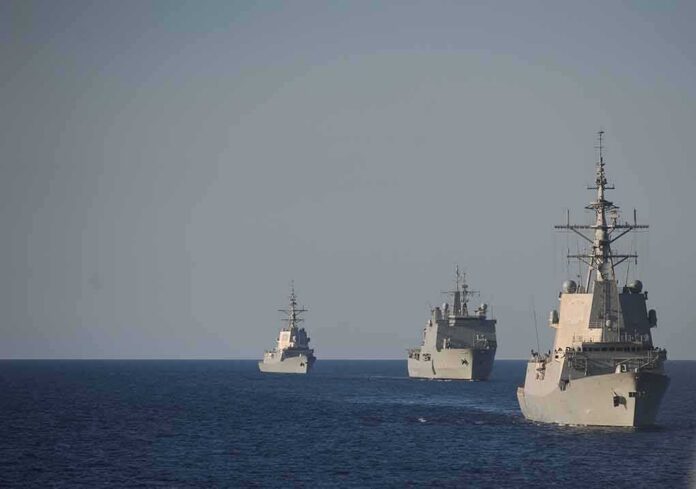
The 2026 National Defense Strategy says the United States will build a strong denial defense along the First Island Chain to stop attacks before they start. The document ties deterrence to clear failure for any aggressor. That means our forces must be close enough to block a rush on Taiwan or the Philippines. A plan that moves our frontline back risks delay and doubt. That is why the strategy treats forward denial as the core posture, not an optional add-on.
Assistant Secretary John Noh told Congress the Department is strengthening posture across the theater with resilient basing, logistics networks, and larger allied roles. Those are practical steps, not slogans. Fuel, parts, runways, and dispersed launch sites decide who shows up first and stays in the fight. If we slide east, those networks stretch thin, and our message to partners weakens. The testimony links denial to hard infrastructure and shared burden, forward and visible.
Why Allies and Geography Make the First Chain Essential
Congressional Research Service maps the First Island Chain through southern Japan, past Taiwan and the Philippines, down toward Indonesia. That arc shapes all movement in the region. It is the fence line for sea lanes and air routes near China. Being inside that arc lets us screen chokepoints, backstop partners, and complicate any blockade. Being outside it yields the near seas to Beijing by default. Geography does not bend to wishful plans or distant staging areas.
The official Indo-Pacific strategy frames alliances as the collective strength that keeps the peace. Modernized ties with Japan, the Philippines, and others create capacity no single nation can match. That capacity depends on visible commitments and real access. Pulling back would make friends wonder if Washington still shows up when pressure mounts. The strategy does not say alliances end without forward forces, but it makes clear reassurance is part of deterrence’s foundation.
Military Voices on Distributed, Forward, and Ready
Admiral Philip Davidson told the Senate that combat-credible deterrence depends on an agile, distributed Joint Force able to deny enemy goals in the first and second island chains. He also stressed interoperable allies and steady reassurance. That vision rejects the false choice between “all in” at one spot or “all out” to the east. It points to many smaller, harder-to-kill positions across both chains that keep options open and the enemy guessing.
Admiral Samuel Paparo has warned that China builds systems to push us out of both chains. That fact cuts two ways. It shows forward forces face risk. It also shows that distance alone will not save us. If their missiles can reach the second chain, then retreat trades early options for late arrivals. A smarter answer is dispersion, hardening, mobility, and air and missile defenses that keep the door open on day one, not day ten.
What Beijing Is Building—and Why Delay Helps Them
The latest China assessments describe options short of war and options for war: coercion, joint firepower strikes, blockade, and an island-landing campaign. They also describe China’s push to project power into both island chains. That means crises will move fast and hit many points at once. If we stand too far back, a blockade could settle in before we arrive. Stopping a fait accompli needs speed, access, and local partners ready to act now.
Some analysts argue that pulling back reduces risk by adding distance. They say fewer targets close to China means fewer chances for miscalculation. That view misses what our strategy, commanders, and allies stress: denial up front prevents war by making aggression fail. It also ignores that we can reduce risk with dispersion and resilience, not absence. The evidence shows forward defense is policy, posture, and signal—and that signal matters when freedom is tested.
Sources:
realcleardefense.com, media.defense.gov, armedservices.house.gov, armed-services.senate.gov, congress.gov