
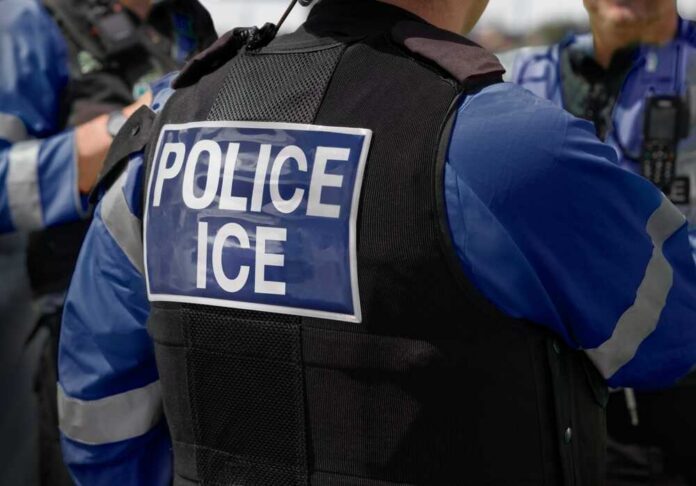
A routine driver’s license visit in rural Pennsylvania turned into a scramble of abandoned semi-trucks and fleeing suspects after ordinary citizens tipped off ICE.
Quick Take
- ICE arrested 13 illegal immigrants at the West Kittanning Driver’s Licensing Center in Armstrong County on April 4, 2026, after public tips flagged an unusually large crowd.
- Witnesses reported people running from the site, leaving vehicles in the street, and jumping fences as agents arrived.
- DHS said those arrested were from Uzbekistan, Kyrgyzstan, and Turkmenistan; one suspect faces added charges for resisting arrest and assaulting an officer.
- The sheriff backed enforcement but criticized planning, while PennDOT denied coordinating with ICE and said the crowd may have been driven by routine paperwork updates.
Citizen Tips Trigger an ICE Operation at a CDL Office
East Franklin Township police and federal immigration agents responded after multiple residents reported an “unusual amount” of non-English-speaking people and tractor-trailers gathered at the West Kittanning Driver’s Licensing Center. Witnesses Zach Scherer and Gary Klingensmith described a line dominated by foreign nationals and commercial rigs, prompting calls to local authorities and DHS/ICE. By later that day, ICE confirmed 13 arrests connected to illegal immigration status concerns.
The incident’s core takeaway is less about one small-town licensing office and more about how quickly enforcement can pivot when local communities see something that looks off and speak up. For conservatives frustrated by years of lax interior enforcement, the episode underscores that public vigilance still matters. For skeptics of government competence—right and left—the chaotic scene also raises questions about coordination, preparation, and what safeguards really work when pressure hits.
Chaos on Arrival Highlights the Enforcement-and-Order Tension
Witness accounts described a sudden rush of movement when agents arrived, with some individuals running across yards, jumping fences, and leaving vehicles behind. Reports also said some tractor-trailers and other vehicles were abandoned in the street, complicating traffic and on-scene control. DHS confirmed one arrestee is facing additional allegations for resisting arrest and assaulting an officer, adding a public-safety dimension beyond paperwork or administrative violations.
Armstrong County Sheriff Frank Pitzer offered a view many local officials share in these moments: support the law being enforced, but don’t underestimate the manpower and planning needed to keep a situation orderly. He reportedly praised the mission while warning that too few agents can be overwhelmed by a large crowd. That criticism is not an attack on enforcement itself; it is a reminder that when operations spill into public spaces, the government’s first job is control, safety, and clarity.
PennDOT Distances Itself as Questions Swirl Over CDL Gatekeeping
PennDOT said it did not coordinate with ICE and emphasized that Pennsylvania issues licenses only to “lawfully present individuals,” using federal SAVE verification. The agency also suggested the crowd might have been driven by routine medical form updates affecting non-domiciled permit holders, rather than a sudden surge of ineligible applicants. That explanation does not fully resolve what witnesses believed they saw, but it does highlight a key limitation: the public sees patterns, while agencies rely on processes that can be difficult to audit in real time.
Why This Matters: Immigration, Work Authorization, and Critical Infrastructure Jobs
The biggest policy significance is the intersection of immigration enforcement and the trucking workforce, a sector tied directly to supply chains and public safety. If unauthorized workers are attempting to obtain or renew CDLs, the issue becomes more than politics—it becomes a question of trust in licensing systems and in the rules that separate legal employment from illegal employment. At the same time, PennDOT’s comments show how states will defend verification systems even as public skepticism grows.
What to Watch Next: Investigations, Coordination, and Public Confidence
As of early April reporting, the arrests were complete and remained under investigation, with no additional detentions announced. The open question is whether this becomes a one-off event or a template: tip-driven enforcement at licensing centers, paired with tighter scrutiny of commercial driver credentialing. For Americans who already believe “the system” protects insiders while leaving ordinary citizens to bear the risks, the next steps—charges, transparency, and process fixes—will do more to shape public trust than any partisan talking point.