
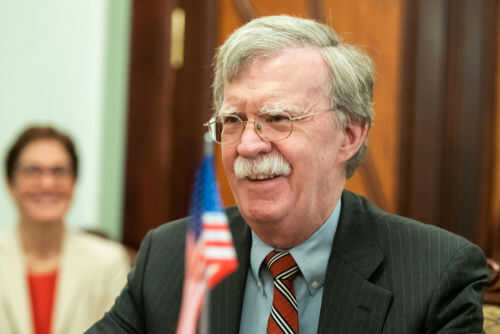
Former National Security Advisor John Bolton publicly criticizes President Trump for failing to pursue regime change in Iran, expressing surprise that the administration hasn’t capitalized on military advantages to permanently end decades of threats from Tehran.
Story Snapshot
- Bolton urges Trump to “finish the job” by toppling Iran’s regime after successful 2025 strikes on nuclear facilities
- Former NSA warns that ceasefires and diplomatic hesitation only strengthen the weakened ayatollahs
- Criticism comes amid renewed Iranian nuclear efforts and threats to close the Strait of Hormuz
- Bolton’s push for regime change highlights tensions between decisive military action and political concerns over gas prices and midterm elections
Bolton’s Push for Regime Change
John Bolton, who served as Trump’s National Security Advisor from 2018 to 2019, argues that toppling Iran’s government represents the only permanent solution to terrorism and nuclear threats facing the West. In a January 2026 opinion piece, Bolton stated that regime change is “the most effective way” to eliminate dangers that have plagued Western nations for nearly five decades. Bolton praises the June 2025 strikes that damaged Iran’s key nuclear facilities at Fordo and Natanz during a 12-day military campaign but expresses frustration that Trump stopped short of delivering a knockout blow to Iran’s leadership and military capabilities.
Ceasefire Criticized as Regime Lifeline
Bolton sharply criticizes the ceasefire announced in January 2026, characterizing it as a critical mistake that allowed Iran’s weakened regime to regroup and survive. The former national security advisor argues that the pause in military pressure gave the ayatollahs breathing room despite their vulnerable position following the devastating strikes on nuclear infrastructure. Bolton points to Iran’s attempts to revive its nuclear program through potential cooperation with North Korea as evidence that half-measures fail to address the fundamental threat. He contends that the Trump administration missed an opportunity to exploit divisions within Iran’s leadership and capitalize on widespread domestic protests against the regime.
Political Calculations Over Strategic Victory
Bolton suggests that domestic political concerns, particularly rising gas prices and upcoming midterm elections, influenced Trump’s decision to pull back from full-scale regime change operations. In interviews and written commentary, Bolton describes Trump as “frantic” and seeking an exit from the conflict rather than pursuing total victory. The criticism reflects a broader tension between those advocating decisive military action to permanently eliminate the Iranian threat and pragmatic concerns about economic fallout and war fatigue among American voters. Bolton notes that while Trump deployed the USS Abraham Lincoln carrier group and set deadlines for Iran to reopen the Strait of Hormuz, the administration ultimately avoided the aggressive follow-through necessary to sink Iran’s navy or support internal regime fractures.
Implications for National Security
The disagreement between Bolton and Trump over Iran strategy illustrates fundamental questions about how America confronts long-term threats from ideologically committed adversaries. Bolton argues that diplomatic approaches have repeatedly failed over decades and that only regime change will end Iran’s support for terrorist proxies like Hamas, Hezbollah, and the Houthis. The former advisor warns that allowing Iran’s regime to survive perpetuates nuclear proliferation risks and regional instability, potentially leading to far worse conflicts down the road. However, the political reality of governing includes managing energy markets that affect everyday Americans, avoiding endless Middle Eastern entanglements, and balancing competing priorities in an election year when voters increasingly question whether Washington elites prioritize their own power over solving real problems.
For many Americans frustrated with decades of inconclusive foreign policy, Bolton’s critique highlights a familiar pattern: bold rhetoric followed by incomplete action that leaves threats unresolved. Whether the answer is the regime change Bolton advocates or a different approach altogether, the underlying concern remains that the government’s strategies serve political survival rather than genuine security solutions. Iran’s weakened state presents an opportunity, but the consequences of both action and inaction carry significant risks that will affect American families through energy prices, military commitments, and long-term security challenges.
Sources:
John Bolton: Iran strike could mean turmoil and bloodshed