
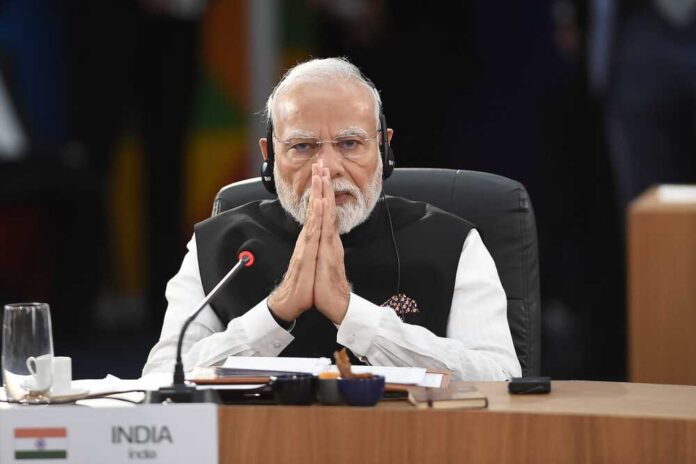
Prime Minister Narendra Modi’s Bharatiya Janata Party is poised to shatter decades of regional dominance in India’s state elections, marking a seismic political shift that could reshape the nation’s power structure for years to come.
Story Snapshot
- BJP projected to win historic first government in West Bengal, ending TMC’s long dominance
- Actor Vijay’s new party set to oust ruling DMK in Tamil Nadu in stunning celebrity political debut
- Modi celebrates with supporters at BJP headquarters as vote counting continues across five states
- Results signal potential BJP dominance ahead of 2029 national elections amid anti-incumbency wave
BJP Breaks Through in West Bengal
The Bharatiya Janata Party achieved a sweeping victory in West Bengal on May 4, 2026, marking the party’s first-ever government in the eastern state. Early trends showed BJP leading massively across the state’s 294 seats, with only one seat remaining pending declaration. The breakthrough ends the Trinamool Congress’s grip on power under Chief Minister Mamata Banerjee, who has not conceded despite the overwhelming results. Suvendu Adhikari is positioned as a potential Chief Minister candidate as the party prepares to form its government.
Celebrity Politics Disrupts Tamil Nadu
Film actor Vijay’s newly launched political party secured a dramatic upset in Tamil Nadu, ousting the ruling Dravida Munnetra Kazhagam party. Vijay leveraged his massive popularity among youth and women voters to challenge the established political order in the state’s 234-seat assembly. Prime Minister Modi publicly congratulated Vijay on his victory, signaling potential cross-party outreach despite their different political backgrounds. The win demonstrates the continuing power of celebrity politics in South India, echoing historical precedents of film stars successfully transitioning to governance.
Modi Addresses Jubilant Supporters
Modi appeared at BJP headquarters in New Delhi to address jubilant party workers as vote counting revealed the scale of the party’s gains. Street celebrations erupted across multiple cities as supporters responded to early trends showing BJP leading in West Bengal and making significant inroads elsewhere. The results covered elections in five states: West Bengal, Assam, Kerala, Tamil Nadu, and Puducherry. While Congress UDF gained ground in Kerala, the overall narrative centered on BJP’s expansion beyond its traditional national strongholds into regions previously dominated by entrenched regional parties.
Anti-Incumbency Wave Reshapes Political Landscape
The election outcomes reflect widespread voter fatigue with incumbent governments in West Bengal and Tamil Nadu. BJP capitalized on anti-incumbency sentiment against Mamata Banerjee’s TMC administration in West Bengal, building on its 2021 campaign that nearly toppled her government. The party’s success demonstrates its continuing national momentum under Modi’s leadership and positions it favorably for the 2029 national elections. These state victories could fundamentally reshape eastern India’s political dynamics, potentially establishing BJP dominance in regions where it previously struggled to gain traction against powerful regional parties.
The Election Commission of India will declare final results once all remaining seats are tallied, at which point BJP will formally begin government formation processes. The political shift marks a significant consolidation of power for Modi and his party, extending their reach into states that have resisted BJP’s advance for decades. For millions of voters who supported change, these results represent hope for new governance models; for opposition supporters, they signal a concerning concentration of power in one party’s hands across India’s federal system.