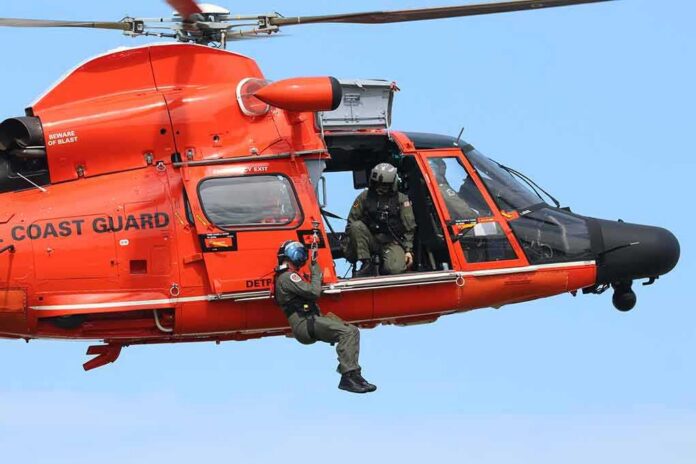
The U.S. Coast Guard launched air and surface crews to search for a Boston-bound jet that vanished off Nantucket with six people aboard.
Story Highlights
- Coast Guard crews are searching off Nantucket for a missing Gulfstream G100 jet reported lost early Saturday.
- The Federal Aviation Administration (FAA) reported losing contact with the aircraft en route from Bermuda to Boston.
- Officials said six people were on board the aircraft when contact was lost.
- Maritime search and rescue leadership rests with the Coast Guard under federal procedures.
What Authorities Confirmed About The Missing Flight
Coast Guard officials said air and surface teams began searching early Saturday after the Federal Aviation Administration reported losing contact with a Gulfstream G100 flying from Bermuda to Boston. Reports describe the search zone as off the coast of Nantucket, a busy corridor for New England air and sea traffic. Outlets citing the Coast Guard said six people were aboard. Authorities have not released identities, the aircraft registration, or the operator. Officials have not reported any debris, survivors, or a confirmed location yet.
Reporters noted the loss of contact occurred early in the morning, but no precise minute-by-minute timeline has been released. The description of the aircraft as a Gulfstream G100 comes from contemporaneous coverage that quoted Coast Guard updates. The immediate launch of both aircraft and cutters fits standard practice when an aircraft may be down over water. That response aims to shrink the search box fast, while light and water conditions still favor finding people alive.
How Search And Rescue Works Over U.S. Waters
Federal procedures assign maritime search and rescue leadership to the U.S. Coast Guard, while the U.S. Air Force handles inland missions. When an aircraft is overdue or contact is lost, air traffic controllers and the Federal Aviation Administration trigger alerts and coordinate with rescue centers to start the search. That structure explains why the Coast Guard is the public lead off Nantucket. The Federal Aviation Administration’s role often centers on alerting, sharing flight data, and aiding coordination rather than daily press updates.
Rescue Coordination Centers direct assets to the likely last known area and expand search patterns as new data comes in. In a case like this, teams may fuse radar returns, Automatic Dependent Surveillance–Broadcast data, last radio calls, and drift models to tighten the grid. Aircraft and vessels then run repeat tracks to cover the area with eyes, sensors, and rescue swimmers. That approach has saved lives in rough seas and cold water, but time and weather always work against survivors.
Why This Matters To Families And Communities
This search is about people first. Six souls on board means six families waiting for news. New England communities know that the waters off Nantucket can be unforgiving, and that every minute counts. Crews are trained to move fast, keep discipline, and fight the clock. That kind of readiness reflects the best of our country: skilled professionals stepping up when lives hang in the balance, without politics, and without excuses.
"Coast Guard Launches Urgent Search Off Nantucket After Boston-Bound Medical Jet Carrying 6 People Vanishes"
➡️ Emergency rescue crews with the U.S. Coast Guard have launched an urgent search operation over open water off the coast of Nantucket after a twin-engine medical jet…
— BreakinNewz (@BreakinNewz01) October 3, 2026
Leaders and neighbors can help by keeping calm and respecting the rescue effort. Sharing only confirmed details prevents noise that can distract from the search. Federal guidance explains that early reports can be brief because teams are working, not talking. As updates arrive, we will track which assets are on scene, how the search box changes, and whether the Coast Guard requests help from partner agencies or civilian mariners under standard call-out practices.
Sources:
facebook.com, wcvb.com, nbcboston.com, pinkpillbox.com, faa.gov