
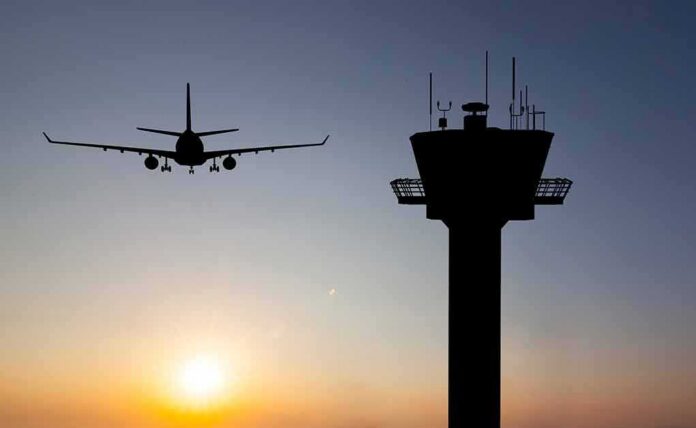
A sudden communications failure at a key Philadelphia air-traffic facility forced the Federal Aviation Administration to pause flights into Newark, Philadelphia, and Teterboro, snarling travel across the Northeast.
Story Highlights
- The Federal Aviation Administration paused inbound flights to three major airports due to frequency problems at Philadelphia’s terminal radar facility.
- Reports described an equipment outage and communications issues that rippled from Philadelphia to Newark and Teterboro.
- Ground stops began late morning with rolling updates as technicians worked the problem.
- Later summaries said a failed primary circuit and a cut backup fiber line compounded the breakdown.
What Triggered the Flight Pauses
The Federal Aviation Administration said it paused flights into Philadelphia International, Newark Liberty, and Teterboro because of “issues with some frequencies” at the Philadelphia terminal radar approach control facility. That facility manages approach traffic for the region. The pause was an immediate safety step to keep aircraft separated while communications were not reliable. Multiple outlets cited the same Federal Aviation Administration statement, matching on both cause and affected airports.
Local reports described the event as an equipment outage at the Philadelphia facility that handles nearby airspace. Because the center supports Newark and Teterboro traffic flows, the disruption did not stay local to Philadelphia. The measure applied to inbound flights first and was adjusted as the situation evolved. Wire copy and station reports showed consistency on the trigger: communications problems linked to the Philadelphia approach control site.
How the Disruptions Rolled Through the Morning
Reports placed the start of the ground stops around late morning, with extensions as crews worked to restore service. Newsrooms noted expected restart windows and later revisions as operations managers reassessed traffic loads. This timing pattern fits normal traffic management practice during equipment failures. Officials aim to meter demand so controllers do not face unsafe radio or radar gaps when planes approach busy arrival streams.
Coverage tied the Philadelphia facility to the broader network, explaining why Newark and Teterboro were included. Terminal radar approach control sites guide aircraft in crowded terminal airspace. When one has a communications fault, nearby airports can be affected even if their local towers are fine. Reuters summarized the Federal Aviation Administration’s description of communications issues and confirmed the limits on incoming flights to the listed airports.
Emerging Technical Detail and Next Steps
Later summaries attributed more detail to the Federal Aviation Administration administrator, saying a primary circuit failed and a backup fiber line was accidentally cut by a construction crew. That account, reported by Euronews, would explain why redundancy did not hold. Early statements used broader terms like “equipment outage,” which often occurs before a root cause is pinned down and documented after action.
Ground stops are a standard safety tool when weather, staffing, runway issues, or equipment problems reduce capacity. The Northeast’s dense traffic magnifies any failure in a key approach facility. Federal Aviation Administration managers typically start with conservative limits, then ease restrictions as systems recover and traffic can be absorbed safely. Monday’s pattern matched that playbook, with pauses, target restart times, and rolling updates for airlines and travelers.
Sources:
rollingout.com, euronews.com, northeasttimes.com, travelandtourworld.com, wpxi.com, cnn.com