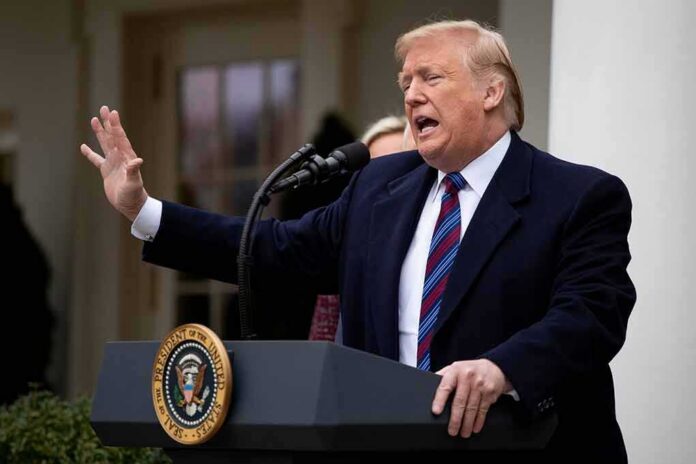
President Trump hosted China’s Xi Jinping for a high-stakes White House state dinner, signaling talks on trade, technology, and security that could shape the balance with America’s top rival.
Story Highlights
- Trump welcomed Xi to Washington for a formal state visit with full honors and a state dinner.
- Both leaders held meetings and delivered planned remarks as part of a tightly scripted schedule.
- The visit aimed to steady a tense relationship while hard issues like trade, Taiwan, and artificial intelligence remain on the table.
- Trump’s rare tarmac greeting underscored the stakes and the need to keep lines open with Beijing.
Formal Welcome And State Dinner At The White House
The White House confirmed that President Trump and the First Lady would host President Xi Jinping and Peng Liyuan for a state dinner in the East Room, with an official arrival at the North Portico. Major outlets reported a lavish welcome on Thursday, with ceremonies and meetings through the day. Reporters noted that both leaders planned public remarks tied to the dinner, reflecting the visit’s high profile. The schedule focused on ceremony and set-piece talks, not freewheeling press time.
President Trump met Xi on the tarmac at Joint Base Andrews, a rare gesture that marked the visit’s importance and the effort to manage tensions without retreating from American interests. Past presidents usually greet leaders at the White House, so the planeside welcome sent a clear signal. The formalities carried the weight of two superpowers trying to avoid missteps, even as disagreements over trade, technology, and regional security loom large. Ceremonial warmth does not erase the rivalry, but it can reduce risk.
Talks Centered On Trade, Technology, And Security
Coverage outlined an agenda that included trade frictions, artificial intelligence risks, Taiwan, and wider security flashpoints. Both sides sought stability after months of strain, including a fragile trade truce and concerns over advanced chips and data flows. The goal, according to analysts, was to keep channels open and set guardrails rather than clinch sweeping deals in one sitting. That approach mirrors how rival powers use summitry to prevent miscalculation while each holds firm on core interests.
Officials mapped out remarks in the morning and again with the evening dinner, suggesting deliverables would be narrow and framed as steps toward steadier ties. That does not mean weakness. It reflects a common pattern in great-power diplomacy: talks buy time and clarity while teams grind on details. For American conservatives, the test is simple. The United States must defend fair trade, protect critical technology, and keep our supply chains secure. Engagement is a tool, not an end.
Why The Optics Matter For U.S. Strength
State visits carry messages beyond the menu. The red-carpet treatment said that America is confident and in charge of its own house while pressing Beijing on behavior that harms U.S. workers and national security. Welcoming Xi at the White House put the burden on China to show responsibility in trade and regional conduct. It also let President Trump speak directly to the American people about goals and red lines, without filters or globalist spin from career bureaucrats.
Media and think tank coverage stressed that summits with rivals often stress signaling over instant breakthroughs. That assessment fits this trip. A calm stage helps the United States lay out clear terms: end unfair trade practices, stop theft of intellectual property, and respect freedom of navigation. The point is not to flatter Beijing. It is to advance U.S. interests while reducing chances of a crisis that could raise prices, strain our military, and hit family budgets here at home.
What Conservatives Should Watch Next
Conservatives should track follow-through on trade enforcement, export controls for sensitive chips, and real penalties for violations. Watch whether new talks lead to firm timelines or working groups with teeth. Pay attention to how the administration moves to secure supply chains, bring production home, and stop China’s access to critical American technology. These steps protect jobs, national strength, and our edge in innovation. Ceremonies are fine; results matter more.
SCOOP!! Ukraine proposed to Trump that he and Xi Jinping jointly call Putin to press Russia toward a ceasefire, two sources familiar with NY meeting tell me
The U.S. side views the proposal as “creative,” sources said
Trump is hosting Xi today for the final day of state visit
— Alex Raufoglu (@ralexdc) September 25, 2026
The visit showed that America can be gracious and tough at the same time. President Trump used a rare tarmac greeting and a formal dinner to keep channels open while holding the line on core interests. Talks do not concede our values or our sovereignty. They test the other side’s willingness to act in good faith. If Beijing wants stable ties, it can prove it in factories, ports, and code. If not, the United States must keep pressure on and protect our people first.
Sources:
youtube.com, abcnews.com, whitehouse.gov, cbsnews.com, apnews.com, cfr.org, cnn.com