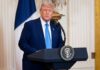

President Trump’s agreement to meet with Senate Majority Leader Chuck Schumer and House Minority Leader Hakeem Jeffries underscores the high-stakes negotiations over a possible government shutdown, with some analysts suggesting Trump could gain political leverage depending on the outcome.
Story Overview
- Trump schedules last-minute meeting with Schumer and Jeffries as shutdown deadline approaches
- Political analysts suggest Trump may benefit from shutdown chaos undermining government operations
- House Freedom Caucus pushes for deep spending cuts while Trump maintains influence over GOP strategy
- Federal employees and essential services face disruption as negotiations remain stalled
Trump’s Strategic Position in Shutdown Negotiations
President Trump’s willingness to engage directly with Senate Majority Leader Chuck Schumer and House Minority Leader Hakeem Jeffries represents an unprecedented involvement of a sitting president in shutdown negotiations. Analysts, including Sarah Binder of the Brookings Institution, note that Trump’s combination of public engagement with Democrats and private encouragement of House Republicans reflects a calculated political approach. This strategy allows Trump to appear as a dealmaker while potentially benefiting from any resulting chaos that could weaken his administration’s opposition and energize his conservative base.
Conservative Republicans Push for Fiscal Responsibility
The House Freedom Caucus continues demanding substantial spending cuts and policy concessions, reflecting genuine conservative concerns about fiscal responsibility and government overreach. These hardline Republicans, many aligned with Trump’s America First agenda, view the shutdown negotiations as an opportunity to force meaningful reductions in federal spending. Their position resonates with conservative voters frustrated by decades of fiscal irresponsibility and bloated government programs that waste taxpayer dollars on unnecessary bureaucracy.
Economic and Political Stakes Mount
A potential government shutdown threatens to disrupt federal services, furlough government workers, and create economic uncertainty in financial markets. Some commentators, such as David Wasserman of the Cook Political Report, suggest that Trump and his allies may tolerate short-term disruption if it advances longer-term conservative goals of limited government. The shutdown could expose the extent of government dependence while highlighting the need for essential versus non-essential federal functions, potentially supporting conservative arguments for smaller government.
Democratic Leaders Face Political Pressure
Schumer and Jeffries enter negotiations from a weakened position, desperate to avoid a shutdown that could expose their party’s inability to govern effectively. Their emphasis on protecting essential services masks deeper concerns about maintaining bloated federal programs that serve Democratic constituencies rather than American taxpayers. The Democratic leaders’ warnings about economic consequences reveal their understanding that any shutdown fallout could damage their political standing and electoral prospects.
Trump Agrees to Meet Schumer and Jeffries to Stave Off Shutdown That Trump Just Might Want https://t.co/86J2x8Q9yU
— Eric Martin (@EricMar25918091) September 29, 2025
Constitutional Governance Versus Political Theater
The shutdown standoff highlights fundamental questions about constitutional governance and the proper scope of federal power. Conservative commentators, including National Review writers, argue that repeated funding crises stem from Congress avoiding its constitutional duty to pass annual appropriations bills. Instead, lawmakers rely on continuing resolutions and omnibus spending packages that prevent meaningful oversight and enable wasteful spending. This breakdown of constitutional processes undermines representative government and fiscal accountability that conservatives champion.
Sources:
Trump administration updates – Sept. 28, 2025
Trump to meet with US congressional leaders in last-ditch …
Trump to meet Democrats with both sides dug in on …