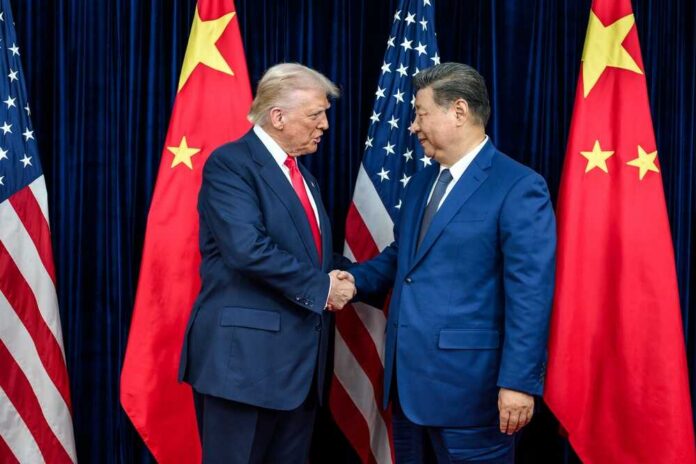
President Trump arrives in Beijing for a critical summit with Xi Jinping facing the weakest negotiating position of his presidency, as China leverages control over rare earth minerals and U.S. setbacks in Iran to dictate terms on trade and Taiwan.
Story Snapshot
- Trump heads to May 14-15 summit politically weakened after failed Iran strikes and domestic poll slides
- China controls 90% of rare earth supply, forcing Trump to back down from tariff threats in 2025
- Xi positions Beijing as mediator in Iran conflict, strengthening China’s hand while U.S. faces military overextension
- Analysts warn summit will ratify “managed equilibrium” favoring Chinese interests over American leverage
China’s Rare Earth Stranglehold Undermines U.S. Bargaining Power
China’s dominance over rare earth minerals has emerged as the decisive factor tilting the summit in Xi’s favor. Beijing controls more than 90 percent of global rare earth refining capacity, materials critical to U.S. military systems and manufacturing. When Trump escalated tariffs beyond 140 percent in 2025, China threatened export restrictions on rare earth magnets, forcing an immediate White House retreat. This pattern reveals how dependence on Chinese supply chains has neutered America’s traditional trade weapons, leaving Trump with fewer options than any modern president facing Beijing.
Iran Debacle Shifts Geopolitical Momentum to Beijing
The failed U.S. and Israeli military strikes against Iran in early 2026 dramatically strengthened China’s position ahead of the summit. Instead of decisive action that would reopen critical energy shipping lanes through the Strait of Hormuz, American forces became mired in an extended conflict that drained resources and political capital. Chinese diplomatic sources confirmed to CNN that the Iran stalemate “strengthened Beijing’s negotiating position,” as Xi now positions China as a potential mediator. This development allows Beijing to leverage its relationship with Tehran while portraying America as militarily overextended and strategically checkmated.
Stark Contrast to Trump’s Triumphant 2017 Visit
The current summit stands in sharp contrast to Trump’s first state visit to China in 2017, when Beijing rolled out a lavish reception and announced $250 billion in trade deals. That visit projected American strength and presidential prestige on the world stage. Nine years later, Trump returns to Beijing after losing consecutive confrontations over tariffs and rare earth access, with his administration struggling to manage simultaneous crises in the Middle East. Former White House official Brett Bruen noted that Xi “senses and exploits” this weakness, entering negotiations with confidence rather than seeking concessions.
Experts Warn of Long-Term Strategic Decline
Foreign policy analysts from the Council on Foreign Relations assess that Xi seeks “control, not confrontation” at the summit, aiming to lock in Chinese advantages without triggering direct conflict. The summit agenda allows Xi to pressure Trump on Taiwan policy and demand the U.S. distance itself from Japan’s newly assertive stance on regional security. Joerg Wuttke of the EU Chamber of Commerce in China captured the dynamic succinctly: the United States is “fighting without winning” while China is “winning without fighting.” This assessment reflects growing concern among American allies that the power balance has fundamentally shifted toward Beijing.
XI 'HOLDS THE CARDS' AT SUMMIT???https://t.co/LIskCzideh
— LukeSlyTalker (@Terence57084100) May 10, 2026
The summit’s likely outcome of “managed equilibrium” may provide temporary stability but risks ratifying China’s structural advantages in critical supply chains and technology sectors. U.S. manufacturers dependent on rare earth materials face continued vulnerability to Chinese export controls, while Beijing accelerates its push for semiconductor self-sufficiency. For Americans who believed tariffs and tough rhetoric would restore fair trade, the summit represents a sobering reality: when Washington lacks alternative supply sources and military bandwidth, Beijing holds the cards that matter most.
Sources:
China holds the aces in Donald Trump-Xi Jinping meet – National Herald India
At the Trump-Xi Summit, China Will Have the Upper Hand – Council on Foreign Relations
Trump heads to China weakened as Xi gains leverage ahead of summit – South China Morning Post