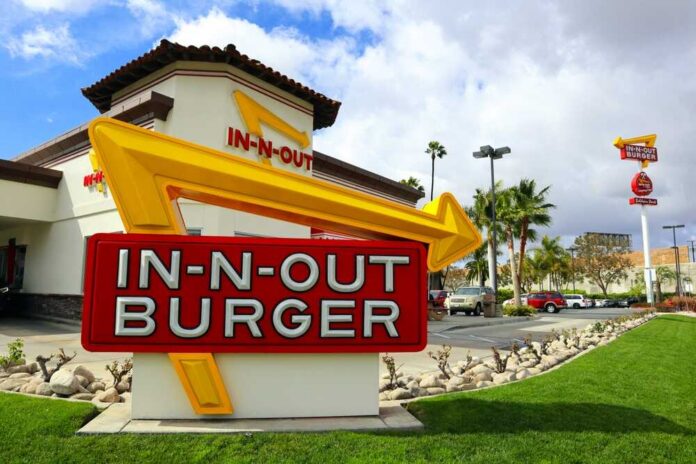
In-N-Out Burger’s owner has publicly rejected the corporate playbook of private equity, delivery apps, and mobile ordering that has transformed the fast-food industry, choosing instead to preserve a business model rooted in face-to-face service and family control.
Story Snapshot
- Owner Lynsi Snyder-Ellingson explicitly rejected mobile ordering and delivery during a March 31 event at Pepperdine University, citing culture and freshness concerns.
- In-N-Out remains privately held and family-controlled since 1948, avoiding franchising, private equity, and external investors that have consumed competitors.
- The chain prioritizes never-frozen beef and in-person interactions over digital convenience, challenging the industry’s rush toward tech-driven scalability.
- Expansion remains deliberately limited to maintain supply chain control, with recent moves into Tennessee representing careful growth versus private equity-fueled overextension.
Defying the Digital Takeover
Lynsi Snyder-Ellingson addressed approximately 1,000 attendees at Pepperdine University on March 31, delivering a clear message to those expecting In-N-Out to follow industry trends. When asked about mobile ordering and online pickup, her answer was unequivocal: no. The owner and president explained that mobile ordering would erode the chain’s culture of personal interaction, the warmth of greetings and smiles that define the customer experience. She also emphasized the freshness factor, noting that digital ordering systems often compromise the quality standards her family has maintained for nearly eight decades.
Family Control Over Corporate Profits
In-N-Out’s resistance extends beyond technology into ownership structure itself. Since Harry and Esther Snyder founded the company in 1948 as a 10-square-foot drive-thru stand in Baldwin Park, California, the chain has remained entirely family-controlled. This stands in stark contrast to competitors who have sold out to private equity firms seeking rapid expansion and maximum returns. While other regional favorites have been absorbed, franchised, or gutted for short-term profits, In-N-Out has steadfastly refused external investors. Snyder-Ellingson’s sole ownership ensures decision-making prioritizes legacy and quality over quarterly earnings reports demanded by Wall Street financiers.
The company’s history reflects deliberate restraint over reckless growth. Throughout the 1980s and 1990s, under Rich Snyder’s leadership, In-N-Out invested in employee training through In-N-Out University rather than aggressive franchise expansion. The chain avoided overextension by limiting locations to areas where fresh beef could be delivered daily from company-controlled facilities. This operational philosophy rejects the private equity model of leveraging debt for rapid scaling, maintaining high margins through operational control rather than volume-driven commoditization that degrades both food quality and worker conditions.
The Private Equity Problem in Fast Food
In-N-Out’s stance highlights a broader concern for Americans who have watched private equity firms devour the restaurant industry. These investment groups typically acquire beloved chains, load them with debt, slash quality to maximize short-term cash flow, then exit with profits while leaving deteriorated brands and displaced workers. The model prioritizes financial engineering over the customer experience and community connections that made these businesses successful. In-N-Out’s rejection of this approach represents a rare stand against the financialization of Main Street America, preserving a business model where owners answer to customers and employees rather than distant shareholders.
Cultural Preservation Versus Convenience
Snyder-Ellingson’s resistance to delivery apps and mobile ordering reflects skepticism toward technology that many Americans share, particularly regarding platforms controlled by a handful of Silicon Valley corporations. Delivery apps extract fees from restaurants while inserting middlemen between businesses and customers, often degrading food quality through delays and impersonal transactions. In-N-Out’s insistence on face-to-face service preserves employment for frontline workers whose roles involve human interaction rather than robotic order fulfillment. This approach resonates with those who believe technology should serve people rather than replace meaningful human connection and craftsmanship.
The chain’s expansion into Tennessee demonstrates that growth remains possible without sacrificing principles. By maintaining supply chain control and refusing to franchise, In-N-Out ensures that quality standards apply uniformly across all locations. This contrasts sharply with franchise models where individual operators cut corners to boost profits, creating inconsistent experiences that erode brand trust. For customers frustrated by the declining quality of corporatized fast food, In-N-Out’s family-controlled model offers proof that businesses can succeed without surrendering to the forces that have homogenized and degraded American commerce.
Sources:
In-N-Out’s owner reveals if they will start allowing online ordering and pickup