
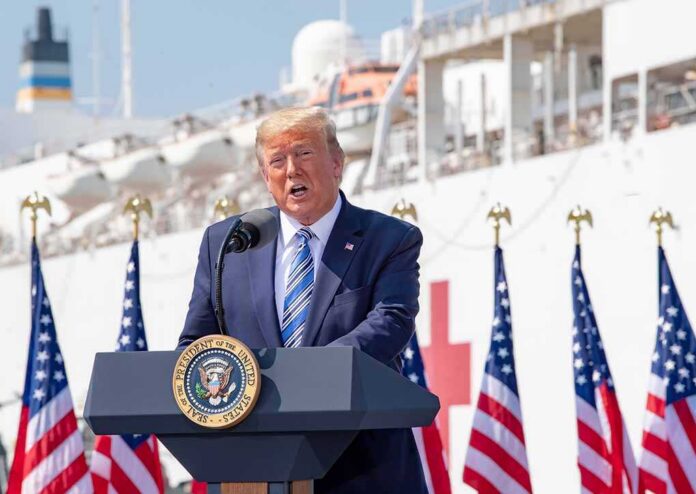
President Trump vowed to be “Mr. Veto” and use lawful executive authority if Democrats seize Congress, signaling a constitutional showdown built on his veto power.
Story Highlights
- Trump told CBS he would use “tremendous powers,” including vetoes, if Democrats control Congress.
- He anchored the plan in the Constitution’s Presentment Clause, which gives the president veto authority.
- He said repeated vetoes can force Democrats to negotiate on policy terms.
- He linked broader executive control claims to a recent Supreme Court decision, though details remain unclear.
What Trump Said On-Air About Vetoes And Executive Power
CBS News reported that President Trump said he was ready to use “tremendous powers,” stressing “tremendous powers, executive powers,” if Democrats win control of either chamber after the midterms. He stated, “I have the ultimate power — it’s called ‘veto,’” and embraced the nickname “Mr. Veto.” He tied broader executive authority to a Supreme Court ruling he called “Slaughter,” which he said strengthened presidential control over agencies and commissions, though he did not cite specifics on air.
In related CBS coverage, Trump again linked his plan to increased control over boards and commissions, and suggested the Court’s decision expanded tools available to a sitting president. The reports focused on his warning that Democrats would try to block his agenda, while he would counter with vetoes and administration action where lawful. These accounts did not include a written legal memo or list of agencies he would direct under this approach, leaving implementation details open.
How The Constitution Backs A Presidential Veto Strategy
The Constitution gives the president clear veto authority over bills passed by Congress. Article I, Section 7 lets a president return a bill with objections. A bill becomes law over a veto only if two-thirds of both the House and Senate vote to override it. This is a core check and balance, not a loophole. Presidents often use veto threats to shape bills or stop bad ones from taking effect unless broad majorities insist otherwise.
Trump’s claim that vetoes can drive dealmaking follows a familiar pattern. He argued that if Democrats send partisan bills, he will reject them until they come to the table. He said, “Historically, you veto for a couple of months and then they come and say, ‘We’ve got to make a deal.’” That is a standard view of veto bargaining in divided government, where a president wields strong “negative power” to block unwanted legislation and push for changes.
What Is Known And What Is Not About “Tremendous Powers”
The on-record statements establish two points: Trump plans to rely on the veto if Democrats control Congress, and he believes a Supreme Court ruling broadened presidential control over parts of the executive branch. The reports do not name the case’s docket or define its scope. They also do not list specific executive orders or agency moves he would take. Those gaps limit how far anyone can rate the reach of the promised actions based only on the interview.
Critics will frame the remarks as a threat to checks and balances. But the veto is a constitutional power that Congress can override only with supermajorities. If Democrats pass bills that raise taxes, grow the bureaucracy, or push “green” mandates, a veto wall would block them unless two-thirds of both chambers agree. That is the design: force real consensus before Washington hikes costs, restricts speech, undermines gun rights, or adds red tape that hurts families and small businesses.