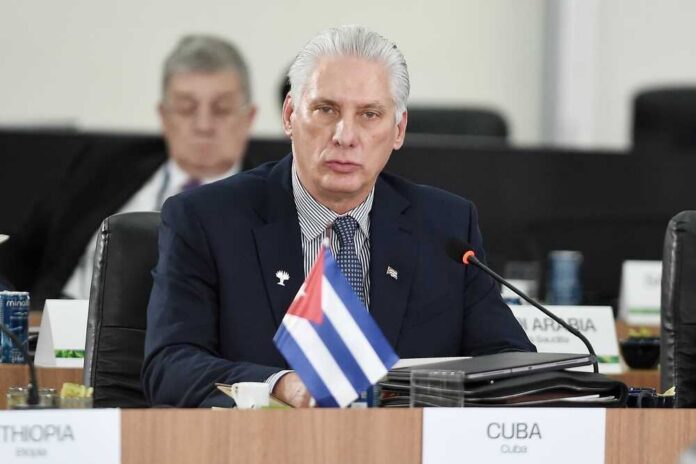
Washington’s latest sanctions on Cuban President Miguel Díaz-Canel have deepened a long fight over pressure, power, and intent.
Quick Take
- The United States imposed sanctions on Díaz-Canel, his wife, and other Cuban officials.[1][3]
- Reports say the move was part of a broader pressure campaign on Havana’s leadership.[1][4]
- Díaz-Canel warned that the United States could pursue three dangerous paths.[2][3]
- The public record shows pressure, but it does not prove a U.S. plan for unrest or war.[1][2][3]
Sanctions Put Cuba Back in the Crosshairs
The Trump administration has imposed sanctions on Cuban President Miguel Díaz-Canel, his wife, and three other individuals.[1][3] The Treasury action froze property and bank accounts in the United States, while reports said the measures were aimed at pressuring the island’s leadership.[1][3] That is concrete proof of economic pressure. It is not, by itself, proof of a formal plan to spark unrest or launch military action.[1][3]
ABC News and other reports said the sanctions were the latest step in a wider campaign against Havana.[3][4] One report said the Trump team had expanded sanctions through an executive order, and another said the pressure on Cuba was intensifying.[1][4] Those reports also noted that the new penalties were tied to U.S. property and banking rules, which is how Washington usually turns financial control into leverage.[1][3]
Díaz-Canel’s Warning Raises the Stakes
Díaz-Canel responded by accusing the United States of making “new threatening statements against Cuba.”[2][3] He said the measures were designed to reinforce the blockade and deepen the conflict between the two countries.[2][3] A separate report said he outlined “three scenarios” the United States may take, including pressure through economics and a feared move toward military aggression.[2][5] That warning matters because it shows how Havana reads U.S. policy.[2][5]
The record also shows the limits of what can be proven right now. The available material does not include the full original speech or transcript behind the “three scenarios” claim.[2][5] It also does not include released U.S. attack orders, war plans, or official directives showing a military strike on Cuba.[1][3] So the sanctions are real, but the most explosive part of the Cuban claim remains unproven in the public record.[1][3][5]
What the Public Record Actually Shows
The evidence points to a hard pressure strategy, not a fully documented invasion plan.[1][3][4] Reports say the sanctions targeted Díaz-Canel, family members, and Cuban institutions, including groups tied to the state’s political and defense structure.[3][7] That supports the view that Washington wants more leverage over Havana. It also explains why Cuban leaders would see the policy as more than routine diplomacy.[3][7]
Trump administration imposes sanctions on Cuban President Miguel D az-Canel in latest move to pressure leadership, reports AP. pic.twitter.com/TsYfd00CuW
— Press Trust of India (@PTI_News) June 5, 2026
Still, the case for military intent is thin. One report said U.S. officials framed the sanctions as part of a push for political and economic opening in Cuba.[4][6] Another said the public rationale centered on repression and national security concerns.[3] Those are strong words, but they are not the same as a public admission of regime change by force.[3][4][6] The difference matters, especially when the region already carries decades of distrust.[1][3][5]
Why This Story Still Resonates
For readers who have watched Washington spend years using sanctions as a political weapon, this story fits a familiar pattern.[1][4] The government applies economic pain, then calls it pressure, accountability, or reform.[1][3][6] Havana then answers with warnings about blockade, coercion, and aggression.[2][3][8] That cycle leaves ordinary people caught in the middle while leaders fight over blame and power.[3][8]
The clearest lesson is simple: the public record confirms pressure, but not every claim built on that pressure.[1][3][5] Díaz-Canel’s warnings may reflect real Cuban fears, and the sanctions do show a tough U.S. line.[1][3][4] But the evidence provided here does not prove that Washington has released a plan to stir unrest or attack Cuba.[1][3][5] It shows the kind of confrontation that keeps the Caribbean on edge.[2][4][8]
Sources:
[1] Web – Cuban president outlines ‘three scenarios’ US may take
[2] YouTube – Latest US sanctions target Cuban President Miguel Díaz-Canel
[3] YouTube – ‘Cuba’s Got Nothing’: Trump Escalates Pressure With Fresh Sanctions
[4] YouTube – Cuban president accuses U.S. of threats
[5] Web – US sanctions Cuban President Díaz-Canel as pressure campaign …
[6] Web – Cuban President Outlines ‘Three Scenarios’ US May Take
[7] Web – US sanctions Cuban President Miguel Díaz-Canel in latest move to …
[8] YouTube – US Imposes Sanctions on Cuban Leader