
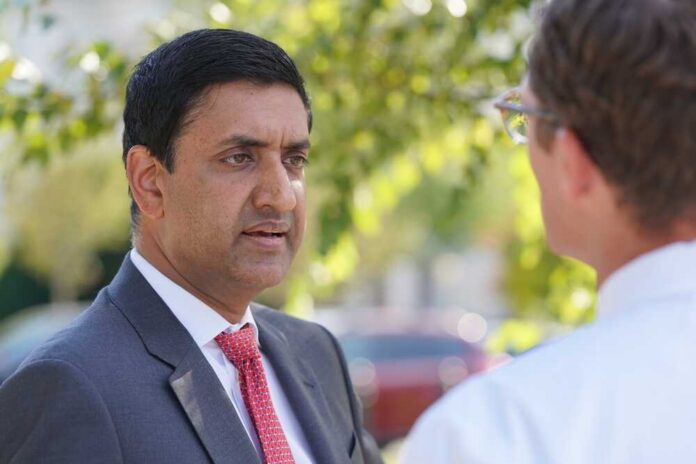
Rep. Ro Khanna’s push to tax wealth down to $50 million signals a sweeping new grab at Americans’ assets, not just billionaires, with huge risks and thin proof it will work.
Story Highlights
- Sanders–Khanna bill sets a 5% annual wealth tax on roughly 938 billionaires, projecting $4.4 trillion in 10-year revenue.
- Khanna touts deficit cuts and social spending tied to the levy, but enforcement on unrealized gains remains untested.
- California’s parallel one-time 5% wealth tax on residents as of Jan. 1, 2026 faces capital-flight and revenue doubts.
- Hoover research warns a net $25 billion hit from departures, undercutting rosy promises of easy money.
What Khanna And Sanders Are Proposing In Washington
Senator Bernie Sanders and Representative Ro Khanna introduced the “Make Billionaires Pay Their Fair Share Act,” which would impose a 5 percent yearly tax on the wealth of about 938 billionaires valued at a combined $8.2 trillion. The sponsors promote an estimate from economists Emmanuel Saez and Gabriel Zucman that the plan would raise $4.4 trillion over ten years. The bill’s summary also lists big federal outlays for health, housing, and childcare as funded by this new stream.
Khanna separately markets a deficit plan that leans on taxing wealth and financial transactions from the billionaire class. His materials claim trillions in deficit reduction from these streams. The promise rests on collecting large sums each year from wealth that changes with markets and is often tied up in illiquid assets. The plan assumes new audits and strong enforcement will deliver and hold over a full decade, even though courts and compliance are unknowns at this scale.
Why Enforcement And Compliance Are The Achilles’ Heel
Federal wealth taxes hit unrealized gains, which are not cash. The bill’s backers say it is workable with new rules, but they do not show a tested model at a 5 percent annual rate. Projected revenue depends on steady valuation of private companies, art, and complex trusts, plus low avoidance. Even advocates cite estimates rather than demonstrated outcomes. That leaves revenue and timing at risk, and it complicates any promise to fund ongoing programs year after year.
Fiscal critics argue these taxes raise far less than advertised. Research from market-oriented analysts finds large behavioral changes when governments tax stock and business stakes at high yearly rates. They warn people move, restructure assets, or fight in court, and that the economy slows as capital leaves. Joshua Rauh’s work at the Hoover Institution on a similar California plan projects a large net loss to state revenue when high earners move away, challenging claims of minimal impact.
California’s One-Time Wealth Tax Test And Its Risks
California voters will face a one-time 5 percent tax on billionaire wealth tied to residency on January 1, 2026. The official analysis expects “tens of billions” in one-time revenue spread over years, with 90 percent directed to health care. It also warns of likely ongoing drops in income tax receipts, in the hundreds of millions or more per year, as a tradeoff. The measure allows installment payments over five years with a cost for deferral.
Silicon Valley leaders have already pushed back, with threats to exit the state if the tax passes. Major media report intense tech sector resistance and concerns about startup cash needs and valuation fights. Governor Gavin Newsom has signaled opposition to the state measure, underscoring the political and economic split. If departures follow, the predicted “tens of billions” could shrink, while lost income taxes mount in later years.
Promises Versus Tradeoffs For Working Families
Bill sponsors tie the wealth tax to big expansions in federal benefits and lower costs for care and housing. Families want relief, but those benefits rely on steady, large revenue from a tax with no proven track record at this rate. If collections fall short, lawmakers either cut programs, raise broader taxes, or borrow more. That is the path many conservatives fear: big promises now, red ink later, and a tax apparatus aimed first at billionaires but creeping down to the $50 million tier and beyond.
Accountability Questions That Still Need Answers
Lawmakers should disclose enforcement plans, valuation rules, appeals paths, and audit budgets before spending the money on paper. They should model capital flight, business relocation, and lost income tax collections, using ranges and real-world experience. California’s test case will be instructive. If it underdelivers or triggers departures, Congress should not scale that model nationwide. Prudence says secure the border, stop waste, and grow energy supply to tame prices before creating a vast new tax on savings and investment.
Sources:
zerohedge.com, khanna.house.gov, cnbc.com, sanders.senate.gov, nytimes.com, politico.com, ips-dc.org