
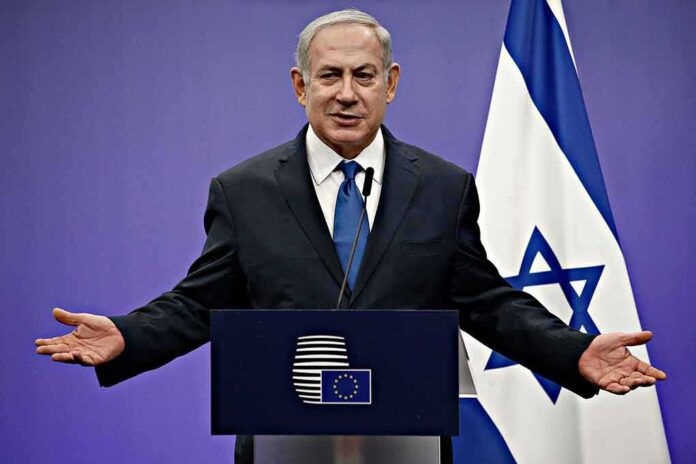
Netanyahu’s rejection of President Trump’s Gaza peace plan has exposed a hard split over whether Hamas must disarm before Israel pulls back.
Quick Take
- Prime Minister Benjamin Netanyahu said Israel rejects Trump’s 15-point Gaza plan and will not withdraw first.
- The plan is described as a phased deal that links Hamas disarmament with an Israeli pullback.
- Netanyahu said Israel wants “genuine” disarmament, not a paper promise.
- Reports also say an important operation is underway in Lebanon, adding another front for Israel.
Netanyahu Draws a Line on Gaza
Prime Minister Benjamin Netanyahu said Israel has rejected President Trump’s 15-point Gaza plan and will not withdraw until Hamas fully disarms. He told ministers that Israel wants “genuine disarmament,” not a weak version that leaves Hamas armed and in place. The message was plain: no pullback, no trust, and no deal unless Hamas gives up its weapons for real.
That stance matters because the proposal was built around a staged trade: Hamas disarms, and Israel later pulls forces back. Reuters reported that the Board of Peace had already backed the core idea that Israeli forces would not withdraw beyond the Yellow Line until Hamas’s weapons were fully decommissioned. Netanyahu’s objection is not about the goal alone. It is about the order, the proof, and who moves first.
Why the Sequence Became the Fight
The available reporting shows Trump’s plan was not a vague slogan. It was a structured roadmap that tied disarmament to withdrawal through stages. But Netanyahu said Israel did not agree to the draft and sent its own comments instead. That puts the debate on a simple but decisive question: can Hamas be forced to disarm before Israeli troops move, or does any pullback have to begin first?
For conservative readers, this is the kind of fight that cuts to the heart of basic security. A deal that rewards armed terror before it is broken can become a trap, not a peace plan. Netanyahu’s language reflects that fear. He said Israel will not accept a fake or partial disarmament, and he tied any withdrawal to the full removal of Hamas’s arsenal. That is the central issue now.
Lebanon Adds a Second Front
The Gaza dispute did not unfold in a vacuum. Associated Press coverage said Netanyahu also said an “important operation” was underway in Lebanon, showing that Israel is still managing pressure on more than one border. That detail matters because it explains why Israeli leaders keep stressing security, control, and military caution. A government fighting on multiple fronts is unlikely to accept a peace plan that leaves a hostile force armed nearby.
Israeli Prime Minister Benjamin Netanyahu rejects a US-led Gaza plan endorsed by Hamas, putting distance between himself and President Donald Trump as he tries to shore up his base ahead of close elections. https://t.co/LoW2Eh2fXz pic.twitter.com/QGEylVvSJv
— AFP News Agency (@AFP) August 9, 2026
The broader picture is one of diplomacy colliding with battlefield reality. Trump and his team promoted the plan as a breakthrough, while Netanyahu’s side quickly framed it as incomplete and unacceptable. The reporting does not show a final, public mechanism that resolves the core dispute over verification and timing. For now, the deal remains defined less by celebration than by a sharp argument over who must move first and who gets to enforce it.
Sources:
youtube.com, washingtonpost.com, nytimes.com, reuters.com, usatoday.com, economictimes.indiatimes.com