Colombia’s 7.4 magnitude earthquake triggered a fast-moving emergency response as officials raced to inspect damage, open rescue lines, and keep more people safe.
Quick Take
- President Abelardo De La Espriella convened an emergency meeting with disaster officials to coordinate the response.
- Airport operations were suspended in several western cities while engineers checked for structural damage.
- Officials reported rising casualty counts, collapsed buildings, damaged homes, and trapped residents.
- Authorities said there was no tsunami threat, which helped narrow the immediate safety risk.
Emergency Response Was Already Underway
President Abelardo De La Espriella said preliminary reports showed 111 dead and 87 injured, while rescue efforts continued in hard-hit areas. The United Nations said the government had activated emergency response mechanisms and kept assessing damage and needs. That matters because it shows the state did not stand still after the quake. It moved into disaster mode while the facts were still being gathered.
Reuters and the BBC reported that western Colombia’s civil aviation authority suspended operations at airports in Pereira, Manizales, Quibdó, Armenia, Cartago, and Buenaventura while inspections were carried out. That is a practical safety step, not a symbolic one. When runway, terminal, and support buildings may be unstable, officials have to stop flights until engineers clear them. In a country already dealing with deaths and collapsed structures, caution was the responsible call.
Cities Reported Serious Damage and Loss of Life
Local officials gave early damage updates from the ground. The mayor of Pereira said at least 18 people died, while the mayor of Cali said about 25 buildings collapsed. Reuters also reported dozens of collapsed buildings and damaged homes, along with a rising toll as reports came in. For families on the scene, those numbers were not abstract. They pointed to real neighborhoods, real rubble, and real rescue needs.
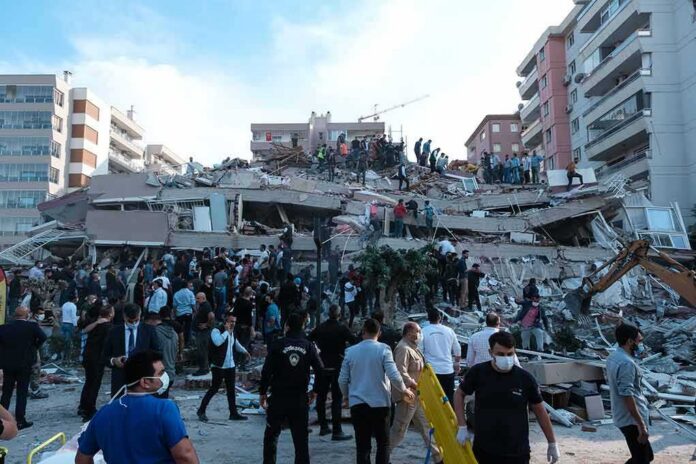
The Associated Press described search teams and civilians picking through destroyed buildings in Cali, passing concrete and rubble down long lines of volunteers. That image matches the broader official picture: a major quake, trapped residents, and a scramble to reach them before aftershocks or further collapse made the scene worse. The United Nations also said rescue work was still going on as officials assessed the scale of the disaster.
Officials Also Moved To Reduce Panic
Authorities said there was no tsunami threat, which helped narrow the danger after the quake hit the Pacific side of the country. That kind of warning matters because it gives people a clear next step and keeps them from fleeing toward fresh danger. NBC News reported that both the United States Geological Survey and Colombia’s geological service placed the quake at magnitude 7.4 near San José del Palmar, west of Bogotá. Scientific agreement on the quake’s size and location gave the response a firm basis.
BREAKING / UPDATE: A powerful magnitude 7.4 earthquake struck western Colombia on the morning of Monday, August 10, 2026 (around 7:34 a.m. local time / 12:34 UTC), causing widespread destruction, collapsing buildings, and claiming at least 111 lives so far, with dozens more…
— Naija Daily Update (@9jaDailyUpdates) August 10, 2026
Still, the public record was changing fast. Different outlets carried different casualty totals as the first day unfolded, which is normal after a major disaster but still confusing for the public. The core facts, however, were already clear: buildings had collapsed, airports had closed for inspections, rescue crews were working, and officials had launched a national emergency response. In plain terms, Colombia was trying to save lives while the ground was still shaking in the news cycle.
Sources:
youtube.com, cnn.com, theguardian.com, reuters.com, abcnews.com, bbc.com, foxweather.com, nbcnews.com