
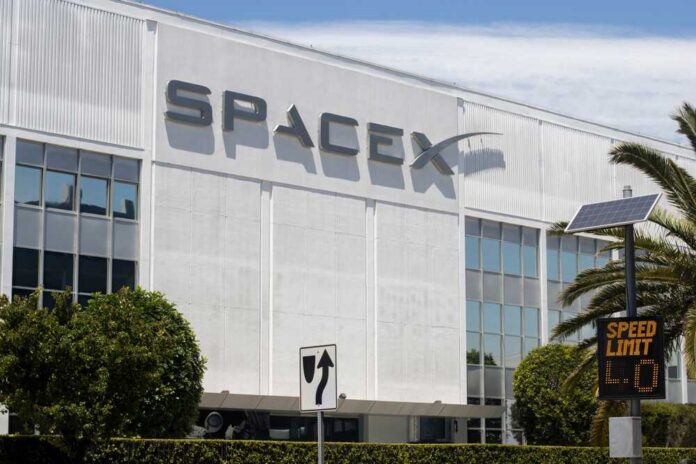
America’s space launch industry careens toward crisis while one company hauls the entire sector on its back, exposing a competitive landscape so lopsided it borders on absurd.
Story Snapshot
- SpaceX executed 61 of 78 U.S. orbital launches in 2022 while competitors scrambled for scraps
- Three underfunded spaceports handle 175 of 176 U.S. launches with just $1.5 million in FAA grants over three decades
- Supply chain chaos, tariff threats, and environmental violations slam competitors as SpaceX scales reusability
- Regulatory barriers and infrastructure deficits threaten to strangle the commercial space economy before it matures
The Monopoly Nobody Wants to Acknowledge
SpaceX doesn’t just dominate American space launches; it virtually owns them. While competitors like Northrop Grumman’s Antares managed a meager six launches and Blue Origin battles EPA violations for dumping acidic wastewater into Florida’s Indian River Lagoon, Elon Musk’s operation executes launches with assembly-line efficiency. This isn’t healthy competition. This represents a dangerous concentration of national security and commercial capability in one company’s hands, yet alternatives remain starved of resources and strangled by red tape that somehow SpaceX navigates effortlessly.
Infrastructure Collapse Hiding in Plain Sight
Cape Canaveral, Kennedy Space Center, and Vandenberg Space Force Base shoulder nearly all U.S. orbital launches despite receiving federal funding that wouldn’t cover a single Falcon 9 mission. The FAA’s Space Transportation Infrastructure Matching grants totaled $1.5 million across thirty years while SpaceX alone invested billions in reusable rocket technology and private launch facilities. Karina Perez from the CCIA Space and Spectrum Policy Center warns that current spaceport infrastructure and regulatory frameworks stretch to their limits, yet Congress treats commercial space like a rounding error in appropriations bills while China pours resources into competing capabilities.
Regulatory Theater Versus Reality
The FAA conducted 22 environmental reviews for launches in 2023, declaring impacts insignificant in every case, then buries operators under Part 450 licensing complexity that smaller firms can’t afford to navigate. SpaceX employs legal armies and regulatory specialists who turn bureaucratic mazes into speedruns while startups drown in compliance costs before their first launch. This isn’t protection; it’s selection pressure favoring established giants. Meanwhile, export controls push allies toward developing independent launch capabilities, shrinking America’s customer base while supposedly protecting technology that commercial operators already demonstrate globally.
Environmental Consequences Industry Ignores
Blue Origin discharged wastewater with acidity levels plunging to 3.8 pH into ecosystems supporting Florida’s fishing economy, killing seagrass beds and triggering algal blooms that devastate the Indian River Lagoon. Space Coast fishermen lose access during launch windows while pollution accumulates from propellant runoff and industrial waste. The billionaire space race treats environmental stewardship as optional, with Jeff Bezos and Musk pursuing expansion plans that prioritize frequency over ecological responsibility. EPA violations become cost-of-business calculations rather than deterrents, and local communities bear consequences while launch companies chase government contracts.
Supply Chain Vulnerabilities Nobody Wants to Discuss
Tariffs targeting Mexico, Canada, China, and the EU inflate costs for rare earth elements and precision components critical to propulsion systems and satellite encryption hardware. COVID-era supply disruptions never fully resolved, and military smallsat demand strains production capacity while manufacturers struggle with thin margins General Howell from Space Command identified. The Aerospace Industries Association warns aerospace exports face threats just as defense megaconstellations require unprecedented production scales. Charles Beames argues America must buy commercial services to outpace adversaries, but supply bottlenecks contradict launch ambitions while competitors play catch-up to SpaceX’s vertically integrated manufacturing that insulates it from vendor chaos.
The Space Launch Industry Is in Big Trouble… Except for You-Know-Whohttps://t.co/KRxx4pd2rl
— PJ Media (@PJMedia_com) April 21, 2026
The Innovation Paradox
SpaceX’s success stems from reusability breakthroughs and operational scale competitors cannot match, yet monopolistic market concentration historically stifles innovation once dominant players eliminate threats. John Willacker from Aerospace Corporation notes launch remains a risky business with thin margins, but those margins disappear entirely when one company captures government contracts and commercial customers through pricing competitors cannot approach. The February 2026 CCIA report urges modernization for in-space manufacturing and lunar operations, yet how does innovation flourish when viable alternatives to SpaceX vanish and regulatory barriers cement incumbency advantages rather than leveling competition?
Sources:
New Report Identifies Major Barriers to Launching a Robust Space Economy
Top 4 Pressing Issues for the U.S. Space Industry This Year
Florida Space Industry Worries
U.S. Private Space Launch Industry Is Out of This World