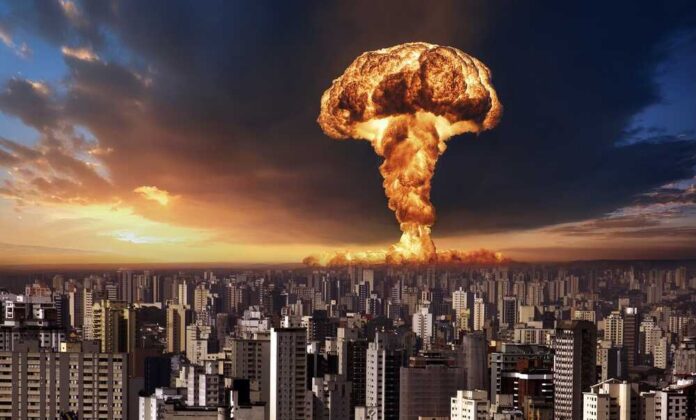
A new report warns the world is drifting back toward a nuclear arms race—this time powered as much by cyber and space technology as by sheer warhead counts.
Story Snapshot
- SIPRI’s Yearbook 2025 says all nine nuclear-armed states are modernizing their arsenals, with operational warheads trending upward.
- Global stockpiles were estimated at 12,241 warheads in January 2025, including about 9,614 in military stockpiles available for use.
- China is expanding fastest, adding roughly 100 warheads per year and completing about 350 new ICBM silos, according to SIPRI.
- Arms-control guardrails have weakened, raising risks of miscalculation during an already unstable geopolitical period.
SIPRI’s warning: modernization is replacing the post–Cold War drawdown
SIPRI’s Yearbook 2025 describes “warning signs” of a new nuclear arms race as long-running post–Cold War reductions lose momentum. The institute’s accounting for January 2025 put the global total at 12,241 warheads, with 9,614 in military stockpiles and a growing share in operational status. SIPRI’s core point is not that totals suddenly spiked, but that deployment, readiness, and modernization trends are moving in the wrong direction.
WORLD FACES NEW NUKE RACE!!!!!https://t.co/H57eTCebwQ
— LukeSlyTalker (@Terence57084100) April 20, 2026
All nine nuclear-armed states—United States, Russia, United Kingdom, France, China, India, Pakistan, North Korea, and Israel—are reported to be pursuing modernization in some form. SIPRI notes that the U.S. and Russia still hold roughly 90% of the world’s nuclear weapons, which means their programs remain the central driver of global risk. Even so, the report frames the overall environment as “dangerous and unstable,” with modernization happening alongside deteriorating trust and fewer enforceable limits.
China’s rapid buildup is reshaping deterrence calculations
SIPRI’s data highlights China as the fastest-growing nuclear force, with estimates that it has surpassed 600 warheads and has been adding about 100 annually. The Yearbook also points to China’s construction of around 350 intercontinental ballistic missile silos, a major infrastructure signal even before counting additional deployed warheads. SIPRI researchers suggest that, at that pace, China could approach 1,000 warheads in the early 2030s, compressing timelines for U.S. planners and allies.
For American voters already skeptical of elite assurances that global threats are “managed,” China’s expansion underscores a hard reality: deterrence depends on credible capability and clear communication, not wishful thinking. SIPRI’s warning also focuses on a “highly technological” race that stretches beyond warhead totals into domains like cyber and space. Those arenas can increase the risk of misreading an adversary’s intent, especially if early-warning systems or communications are disrupted during a crisis.
Arms control is weaker, and “guardrails” matter when tensions spike
SIPRI’s Yearbook frames the current moment as more precarious because arms-control structures have eroded. The post–Cold War era relied on negotiated limits and verification regimes that reduced deployed weapons even when rivalry persisted. SIPRI’s analysis argues that those conditions no longer reliably hold, which raises the stakes of day-to-day geopolitical shocks. The report’s warning lands during a period still shaped by Russia’s war in Ukraine, a conflict widely viewed as having hardened threat perceptions.
Spending pressures and domestic trust collide with national security needs
SIPRI estimates nuclear powers collectively spend on the order of $100 billion per year on nuclear weapons, a figure that can strain budgets and intensify political friction at home. The United Kingdom, for example, has reaffirmed its nuclear deterrent commitments while navigating financial and industrial constraints. For taxpayers—right and left—this kind of spending fuels a broader question: if governments can fund expensive strategic programs, why do basic domestic priorities still feel neglected or mismanaged?
SIPRI’s data does not provide post–June 2025 updates, so it cannot confirm how 2026 policy choices have changed arsenals since the report’s release. Still, the Yearbook’s measurable indicators—rising operational emphasis, accelerating Chinese growth, and modernization across all nuclear states—signal a world where deterrence is getting more complex and potentially less stable. For Americans, the practical takeaway is straightforward: credible defense, serious diplomacy, and accountable government are not optional when strategic risks are rising.
Sources:
World faces new nuclear arms race, researchers warn
Nuclear risks grow as new arms race looms—new SIPRI Yearbook out now
World faces new nuclear arms race, SIPRI warns