
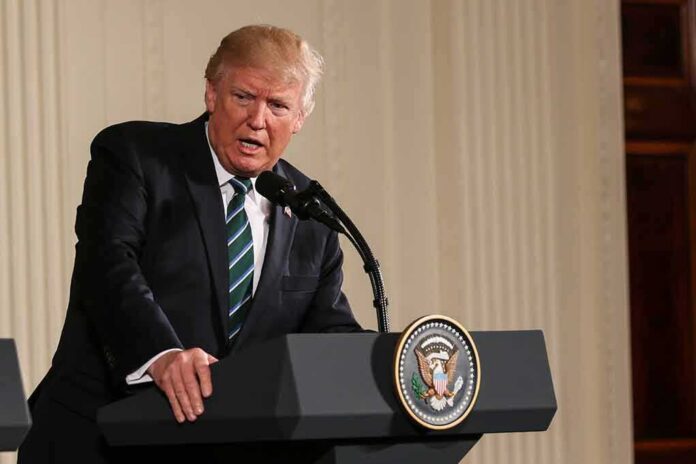
President Trump’s joke about a third term at the rescheduled White House correspondents’ dinner put the Constitution back in the spotlight.
Quick Take
- Trump said, “the third time will be better yet,” during the dinner speech, drawing laughs and applause.
- He then softened the line by saying, “I’m only kidding,” after the remark.
- Coverage shows this was not the first time he has floated the idea of staying on beyond two terms.
- The 22nd Amendment still says no person shall be elected president more than twice.
Trump Revives Third-Term Talk at the Dinner
President Trump used the rescheduled White House correspondents’ dinner to mock the press and revive talk of a third term. He told the room that “just like my presidency, the second time is always better” and added that “the third time will be better yet.” The Associated Press reported that the line came during a speech to a packed hall of journalists and that the crowd responded with applause.
The joke landed inside a larger speech that was already designed to needle reporters and rerun a canceled event. The dinner had been moved from April after a shooting disrupted the original plans, and Trump opened by saying, “As I said three months ago, the show must go on.” Other coverage said he later put the line in lighter terms, telling the audience, “I’m only kidding.”
A Familiar Theme, Not an Isolated Remark
This was not the first time Trump has made third-term references. Reuters reported in March that he said he was serious about the idea, while ABC News later said he was “not joking” about possibly seeking another term. Other reports have described the theme as something he keeps teasing, not a one-off slip. That pattern matters because it keeps the question alive even when the law itself appears settled.
Trump has also used campaign-style settings to repeat the same message. Reporting on a Georgia rally said he joked about a third term there as well, then made clear he was joking. The White House correspondents’ dinner added another public stage for the same line, this time with a “Trump 2028” hat in the mix, which pushed the moment beyond a simple quip and into a broader political signal.
The Constitutional Wall Remains in Place
The legal problem for any third-term push is plain. The 22nd Amendment says, “No person shall be elected to the office of the President more than twice.” The Constitution Center reproduces that text, and Reuters said Trump did not explain any constitutional path around it. Legal experts quoted across several outlets said the amendment blocks another election, which means the speech line does not by itself create a real route back to the ballot.
There is some fringe discussion about loopholes or unusual service paths, but those ideas remain disputed. FactCheck.org quoted one professor who argued the amendment bars being elected again, not necessarily serving in some other way. Even so, other legal analyses say the safer reading is that a third Trump term is barred unless the Constitution is changed. That leaves Trump’s remarks in the realm of political theater, not settled constitutional change.
Why the Message Still Matters
For Trump supporters, the bigger issue is not whether the joke was literal. It is that he keeps projecting strength, confidence, and control while the media and legal class rush to treat every line as a crisis. The dinner remarks showed that dynamic again. Trump tied the joke to success and improvement, then let the crowd react. That keeps him centered in the news cycle and reminds voters that he still commands the room.
BREAKING: In an interview this morning Donald Trump was asked if his announcement that he intends to run for a third term means Barack Obama can run a third time too, and he got silent and frowned for several seconds, folded his arms across his chest, and said, “No.”
— The Halfway Post (@HalfwayPost) July 25, 2026
At the same time, the Constitution still sets the outer boundary. Any real attempt to seek another term would run into the clear text of the 22nd Amendment, likely spark court fights, and force party and election officials to answer hard questions. TIME said courts would likely be asked to stop such an effort if it ever became concrete. For now, the story is a political tease with real constitutional limits behind it.
Sources:
youtube.com, lmulawreview.scholasticahq.com, bbc.com, factcheck.org, lyldenlawnews.com, reuters.com, abcnews.com, usatoday.com, politifact.com, news.northeastern.edu, nytimes.com