Chuck Schumer’s new Anti-Corruption Bureau plan would carve out a powerful, permanently funded watchdog over the presidency that is largely beyond President Trump’s direct control.
Story Snapshot
- Schumer’s bill creates a new Anti-Corruption Bureau with broad subpoena and enforcement powers focused on the executive branch.
- The bureau’s funding and leadership would be shielded from presidential control, raising major questions about separation of powers.
- The bill lets private citizens and state attorneys general sue to recover money tied to alleged “presidential corruption.”
- Democrats openly frame the bill as a response to President Trump, branding him “grifter in chief” and accusing him of self-dealing.
Schumer Unveils a New Anti-Corruption Bureau Aimed at Trump
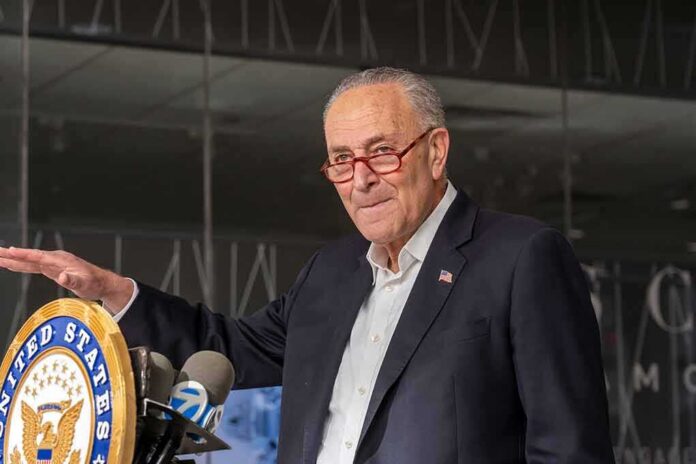
Senate Minority Leader Chuck Schumer, a Democrat from New York, has introduced the Anti-Corruption Bureau Creation Act, a bill that would build a brand-new federal agency to investigate alleged corruption in the executive branch. During a Senate floor speech and related events, Schumer tied the proposal directly to President Trump, calling him “grifter in chief” and accusing him and his family of turning public office into personal profit. Democrats describe the bill as the “biggest, boldest and broadest” anti-corruption push yet.
Schumer’s public remarks show that the bill is not a generic ethics clean-up; it is framed squarely as a response to what Democrats call “unprecedented corruption” in the Trump administration. He claims Trump has “turned the Oval Office into his personal ATM” and argues that ordinary watchdogs were “not built for this moment,” so his bureau would bring “all the guardrails Trump has weakened under one roof.” That framing matters for conservatives because it signals an agency designed with Trump—and future populist presidents—in its sights.
What the Anti-Corruption Bureau Would Do
According to Schumer and Democratic summaries, the Anti-Corruption Bureau would be an independent federal agency focused on executive-branch behavior, with sweeping power to “follow the money” and “expose corruption.” It would combine and replace pieces of several existing watchdogs, including federal ethics and election offices, into one centralized bureau. The bureau would have subpoena power, broad investigative reach, strong enforcement authority, and the ability to claw back what it calls “ill-gotten gains” from presidents, senior officials, campaign figures, and major government contractors.
The bill also creates a new “private right of action” so individuals and state attorneys general can sue “in the name of the United States” to recover money supposedly taken through presidential or executive-branch corruption. Schumer says the model mirrors the federal False Claims Act, which lets whistleblowers sue over fraud against the government, but here the target is “presidential corruption” and related self-dealing. He argues this will “get Americans their money back” if a president or “cronies” use government power to enrich themselves. For conservatives, that opens the door to activist-driven lawsuits whenever a president’s business or donor ties are unpopular.
A Watchdog Insulated from the President, Not Voters
A key feature of Schumer’s plan is how far it goes to shield the new bureau from presidential influence. The agency would be led by a seven-member board of commissioners, confirmed by the Senate, with fixed terms and requirements for partisan balance—three Democrats, three Republicans, and one independent. The structure is marketed as “insulated from partisan politics,” but in practice it concentrates long-term power in a small, unelected board that can outlast elected presidents and respond more to Beltway priorities than voters.
The bill seeks to prevent any president from shutting down or defunding the bureau by giving it a self-sustaining funding source similar to the Federal Reserve, which relies on interest earnings instead of yearly budget votes. It also proposes rules so a president cannot easily fire commissioners or leave the bureau without a quorum; instead, a panel of judges would appoint temporary replacements. Those design choices matter for constitutional conservatives, because they shift oversight of the presidency toward semi-permanent regulators and the courts, away from direct democratic accountability through elections and Congress.
Targeting Trump While Reshaping the Balance of Power
Schumer’s bill is part of a broader Democratic effort to paint Trump-era policies as corrupt and to lock in new controls on future presidents. Related press releases boast that the initiative will “expose Trump’s self-dealing,” stop “presidential profiteering,” and prevent presidents from using public office “for personal profit.” Another allied proposal, the Ban Presidential Plunder of Taxpayer Funds Act, responds to a reported Trump attempt to get a large tax settlement and seeks to stop presidents from abusing power to steal taxpayer money. Together, these bills show a strategy: define Trump-style populism as corruption, then build permanent legal tools to contain it.
🚨WATCH: Sen. Chuck Schumer (D-NY) introduces the Anti-Corruption Bureau Creation Act, claiming Congress needs to act "more strongly than ever before" because of "grifter-in-chief" President Trump.
📹: C-SPAN pic.twitter.com/Yz5sChn34I
— Off The Press (@OffThePress1) July 30, 2026
For conservatives who care about limited government, this raises serious concerns. Existing laws already ban bribery, fraud, and self-dealing; Congress can investigate and impeach; voters can fire a president at the ballot box. Schumer’s plan adds another powerful, semi-independent layer, with its own money, its own board, and its own litigation pipeline, all built in direct reaction to one president. That kind of entrenched bureaucracy can easily drift from checking clear criminal acts to policing political enemies, business ties, and policy choices it dislikes.
Sources:
youtube.com, foxnews.com, spectrumlocalnews.com, c-span.org, facebook.com, democrats.senate.gov, commondreams.org