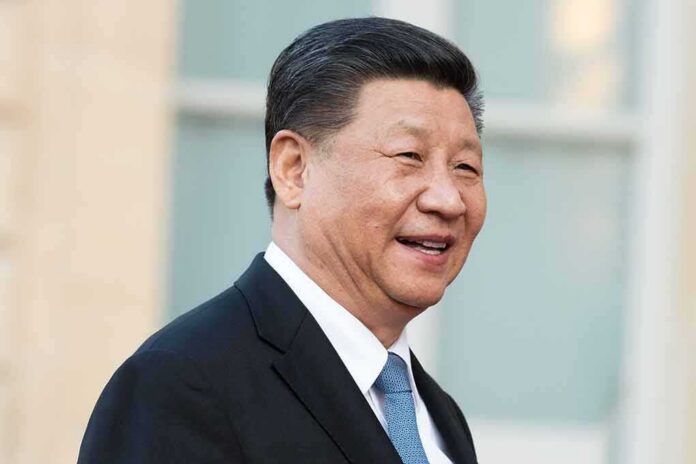
A rare tarmac hug between President Trump and Xi Jinping in China headlined a made-for-TV welcome packed with military pageantry and powerful images.
Story Highlights
- Xi broke decades of protocol to greet President Trump on the tarmac amid full military pomp.
- Red carpet, honor guard, and dancers created striking visuals for broadcast at home and abroad.
- Chinese state messaging framed the welcome as “reciprocity” for Trump’s earlier airport greeting.
- Live coverage showed a handshake turn into a brief embrace at the foot of Air Force One’s stairs.
Choreographed Welcome Signals High Stakes and Careful Planning
Chinese organizers staged a full ceremonial reception as President Trump landed in China. Reporters on scene described a red carpet, military honor guard, and children with flowers. Fighter jets flew overhead. Coverage called it a carefully choreographed diplomatic moment designed for viewers. Cameras captured each step, from the aircraft door to the carpeted walk, with rows of performers set as a living backdrop to the leaders’ arrival and first exchange. The pageantry set the tone for talks that follow.
Television shots showed uniformed regiments and performers placed with exact spacing for symmetry. A military band played both national anthems. Dancers waved flowers, pompoms, and both nations’ flags. The scene looked built for broadcast, with bright colors and tight formations that read well on screen. The greeting sequence flowed from handshake into a brief embrace. The leaders then walked the carpet while flag-waving performers cheered in rhythm, underscoring the event’s visual power.
Protocol Break: Xi’s Personal Tarmac Greeting Marked a Rarity
Chinese leader Xi Jinping does not usually meet foreign leaders on the tarmac. Multiple outlets reported that this greeting was a rare break with long-standing practice. The reports said it was believed to be the first time Xi personally greeted a United States president at arrival. That choice gave the moment added weight. It raised the signaling value of the images and suggested Beijing wanted the welcome to stand out in memory and in news coverage.
China’s official messaging supplied a clear explanation for Xi’s presence. State accounts said Xi cited reciprocity, noting that President Trump and First Lady Melania Trump had greeted him at Joint Base Andrews and hosted a grand ceremony earlier in Washington. Xi described China as a nation of etiquette with a tradition of reciprocal courtesy. Outlets repeated that rationale, which offers a straightforward protocol reason while still delivering strong pictures for domestic audiences.
Broadcast Optimization: Images Built to Travel Fast
Live feeds focused on the foot of the aircraft stairway, where the handshake flowed into a light embrace. Producers then framed the walk along the red carpet between cheering performers and flags. The visuals were clean and striking. They were easy to clip, share, and replay across platforms. Those images support two goals at once: diplomacy with the United States and a display at home of order, scale, and respect for the visiting American leader during a high-profile week of meetings.
Xi Greets Trump With Tarmac Hug.
Chinese President Xi Jinping broke protocol yesterday and met President Trump at the bottom of Air Force One's stairs in Shenzhen, China, with a handshake and a hug. See photos here.
The gesture returned the welcomeTrump gave Xi at Joint Base…— WINaCAR (@WinACarNow) November 19, 2026
The ceremony’s design fits a broader pattern in Chinese political communication. High-level events often serve both protocol and messaging. Visual staging can project control, national pride, and global status, even when framed as standard diplomacy. Here, the orchestration created a narrative arc that began at the aircraft door and ended with a red-carpet walk. That arc allowed state outlets to highlight courtesy and strength without lengthy text. The pictures did most of the work, by design.
What It Means for U.S. Interests and Conservative Priorities
President Trump arrived for tough talks on security and trade while facing a showpiece welcome in Shenzhen. Beijing’s framing as reciprocity set polite terms, but the stagecraft served its own aims. Massive ceremony can boost China’s image at home while it negotiates hard on issues that affect American jobs, energy costs, and supply chains. The Trump administration’s task is to accept courtesy without ceding leverage, and to keep the focus on concrete outcomes for American workers and families.
Conservatives value clarity and strength. This moment shows both the risk and the opportunity. China excels at visuals that shape public mood. That is why precise American goals matter now. Energy security, fair trade, and strict technology protections should guide each handshake and photo. Polite ceremony does not set policy. Results do. The administration can welcome respect on the tarmac while demanding balanced deals that defend American industry and the constitutional freedoms that make that industry thrive.
Limits of the Evidence About the Embrace Itself
Reports confirm the event’s tight choreography. They do not show that the hug itself was preplanned or rehearsed. The available sources document the red carpet, military elements, performers, and official messages. None cites a planning memo or witness who says the leaders agreed in advance to embrace. That means the embrace could have happened within a planned ceremony without being scripted as a specific step in the sequence.
Sources:
pjmedia.com, bbc.com, nytimes.com, wmuk.org, news.abs-cbn.com