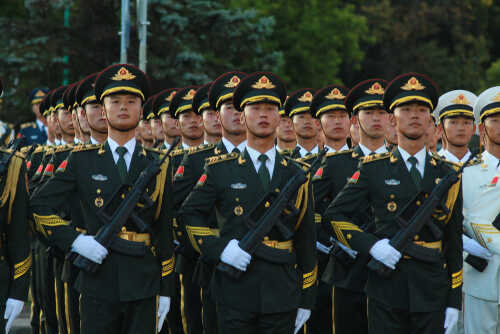
The People’s Liberation Army’s new training cycle threatens regional stability, raising alarms in Taiwan and Japan.
Story Highlights
- China’s PLA begins its 2026 training cycle with a focus on Taiwan and threats to Japan.
- The drills incorporate advanced military technology, including hypersonic missiles and stealth fighters.
- Taiwan and Japan express concerns over the military exercises near their borders.
PLA’s 2026 Training Cycle: A Regional Power Play
On January 4, 2026, China launched its annual military training cycle, featuring joint drills across its Army, Navy, Air Force, and Rocket Force. These exercises are notably focused on potential invasion scenarios of Taiwan and include warnings to Japan regarding disputed territories. This year’s drills incorporate state-of-the-art military technology, such as the hypersonic DF-17 missiles and J-20 stealth fighters, marking a significant escalation in China’s military capabilities.
The exercises have drawn international attention, primarily due to their explicit focus on Taiwan and the integration of advanced systems. This development comes against a backdrop of increased tensions in the region, with Taiwan reporting over 300 airspace incursions monthly. The drills have been linked to Xi Jinping’s military modernization goals, emphasizing readiness for a potential confrontation over Taiwan, a move that has further strained relations with neighboring countries and the United States.
International Reactions and Strategic Implications
Japan has expressed strong objections to China’s military exercises, particularly due to their proximity to the disputed Senkaku Islands. The Japanese government has protested the increased Chinese Coast Guard patrols near these islands, viewing them as aggressive posturing. Meanwhile, Taiwan views these drills as a “two-pronged” coercive strategy, aimed at undermining its resolve and signaling Beijing’s readiness to assert its claims over the island.
The United States, aware of its defense commitments in the Indo-Pacific, is closely monitoring the situation. The exercises are seen as a strategic deterrence aimed at undermining U.S. influence in the region. This has prompted discussions on enhancing defense cooperation with Japan and Taiwan to counterbalance China’s growing military prowess.
Potential Long-Term Consequences
In the short term, these drills heighten the alert levels in Taiwan and Japan, testing their military readiness and diplomatic resolve. In the long run, they contribute to the normalization of coercive tactics by China, expediting its military objectives for 2027. The exercises also have significant economic implications, potentially disrupting shipping routes through the Taiwan Strait, and politically, they strain U.S.-China relations further, pushing Japan to consider bolstering its military capabilities.
As China continues to flex its military muscle, the geopolitical landscape in the Indo-Pacific remains tense, with regional players recalibrating their strategies in response to Beijing’s assertive moves. The 2026 training cycle serves as a clear reminder of China’s ambitions and the challenges they pose to regional stability and global security.
Sources:
China’s People’s Liberation Army Begins Annual Training Cycle
China Launches 2026 Combat Drills Highlighting Joint Force Warfare
Focus Taiwan: Cross-Strait Developments
China-Taiwan Update: January 2026