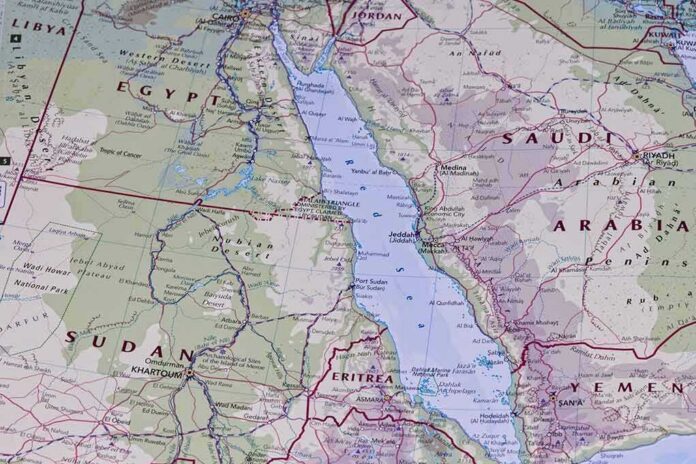
Saudi-backed Yemeni forces surged along the Red Sea coast, driving Iran’s proxy from key ground at the Bab el-Mandeb gateway that moves global trade.
Story Highlights
- Reuters reported a “lightning advance” retaking ground from Iran-backed Houthis near Bab el-Mandeb.
- Government units seized positions in Dhubab and pushed toward Mocha under Saudi air cover.
- A military spokesperson claimed control of the strait’s approaches and the Dhubab–Mocha road.
- Independent verification of full control remains limited in early reports.
Counteroffensive Regains Strategic Ground On The Strait
Reuters said Yemeni government forces, backed by Saudi Arabia, moved fast on Monday to retake the coast around the Bab el-Mandeb Strait and advanced toward the port city of Mocha. Military and government sources described gains that pushed Iran-backed Houthi fighters out of many areas seized last month. This coastal strip controls a narrow sea lane that links the Red Sea to the Gulf of Aden. Ships crossing between Asia and Europe rely on this route for safe and timely passage.
Reports from regional outlets matched key parts of the Reuters account. They said government units took Dhubab, secured nearby high ground, and moved up the road toward Mocha with heavy Saudi air support. The coalition described “round-the-clock air support” and “air protection” for the waterway during the push. Additional reporting identified pro-government formations, including the Southern Giants Brigades and the Nation’s Shield forces, among troops on the ground. Together, air and ground action suggest a planned drive to reopen the corridor.
What Control Means For Trade, Security, And The U.S.
A Yemeni military spokesperson said government forces “succeeded in controlling Bab al-Mandeb” and secured the road between Dhubab and Mocha. If sustained, this weakens an Iranian proxy grip on a chokepoint that shapes shipping costs and insurance for global goods, energy, and food. It also reduces risk to partners that count on stable sea lanes. For the United States, safer Red Sea traffic protects consumers from higher fuel and freight prices that hit family budgets first.
Reuters noted limits on early verification. The outlet said it could not independently confirm the full extent of the advance at the time of publication. That caution matters. Some reports differ on whether Mocha itself was retaken or only threatened. Still, multiple sources agree on Dhubab and nearby positions, which anchor any secure line on the strait’s mouth. The difference between controlling key terrain and every mile of coastline is real, but both change facts on the water.
Iran’s Proxy Claims And The Information Fight
Houthi officials denied being pushed out and earlier boasted of taking control after September gains. Independent commentary and regional reporting described how their push included Mocha and nearby islands, extending reach over the Bab el-Mandeb coastline before this counterattack. Those claims helped Tehran’s ally project power over a route that moves a large share of the world’s trade. Today’s reports challenge that story by pointing to fresh losses and a reopened road grid near the strait’s entrance.
Saudi-backed Yemeni forces have expelled the Houthis from key areas surrounding the Bab el-Mandeb Strait on the Red Sea following a major counteroffensive. https://t.co/5tQiEfjFNs
— Semafor (@semafor) October 6, 2026
The lesson for readers is clear. Control at Bab el-Mandeb can shift fast. Confirmed footholds in Dhubab and along the approach road matter more than slogans. They decide who can fire on ships, who sets checkpoints, and who denies safe passage. Saudi-backed gains, if held, blunt Iran’s leverage and protect trade. That is good for American wallets, energy security, and the principle that free commerce should not bow to militias. We will track satellite images, official maps, and on-the-ground video as they emerge.
Sources:
pjmedia.com, ua.news, algemeiner.com, ijr.com, news.sbs.co.kr