
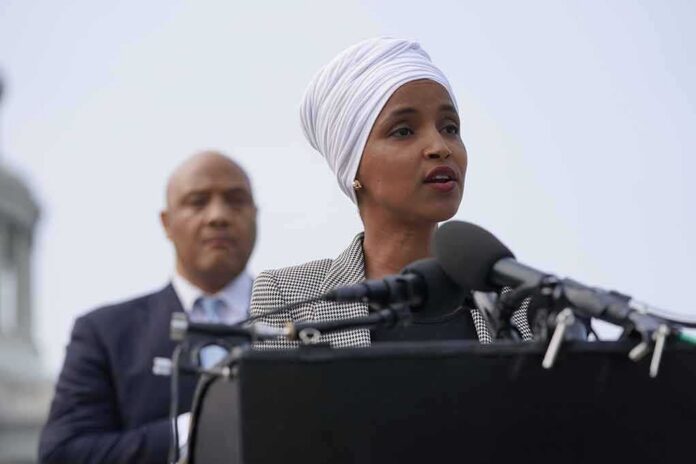
Rep. Ilhan Omar’s new bill would strip roughly $140 billion from border enforcement and hand it to local grants and nonprofits.
Story Snapshot
- Omar introduced the Make ICE Pay Act after a Minnesota enforcement surge.
- The bill seeks to redirect about $140 billion from Immigration and Customs Enforcement and Customs and Border Protection.
- Funds would flow to states, cities, schools, small businesses, and nonprofits tied to enforcement impacts.
- The plan challenges recent long-term funding Congress set for border enforcement.
What Omar’s Bill Would Do With Previously Approved Border Funds
Representative Ilhan Omar introduced the Make ICE Pay Act to take nearly $140 billion that Congress set aside for Immigration and Customs Enforcement and Customs and Border Protection, and send it to local recovery and reimbursement efforts. Her office links the timing to the end of “Operation Metro Surge” in Minnesota, describing the bill as a response to community harms from large enforcement actions. The plan would set up a grant program that pays state and local costs and supports schools, nonprofits, and small businesses facing fallout from raids.
The bill frames the money as already locked into immigration enforcement under a previous package, and attempts a policy reversal by moving that large sum into community aid instead. Reports describe the transfer as blocking or redirecting the roughly $140 billion before it reaches frontline enforcement accounts. Supporters say these grants would help places that face property damage, lost wages, and service strain during federal operations, and they want the Department of Housing and Urban Development to administer relief.
How This Fits the Bigger Fight Over Immigration Budgets
Congress recently enacted Department of Homeland Security funding that included long-term appropriations for the U.S. Border Patrol and Immigration and Customs Enforcement through fiscal year 2029, locking in the basic enforcement mission and its budget path. Separate analysis shows that the larger enforcement package under the “One, Big Beautiful Bill” added well over one hundred billion dollars to border and immigration operations across the Department of Homeland Security and the Department of Defense. Omar’s bill challenges that direction by pulling money toward non-enforcement grants tied to local recovery.
Budget rules for immigration enforcement have long been a tug-of-war between Congress and the executive branch, including fights over moving money between accounts after a bill is signed. Government Accountability Office materials document repeated shifts within Department of Homeland Security accounts to cover Immigration and Customs Enforcement needs, highlighting how volatile and contested this space has been. The Make ICE Pay Act takes the opposite tack, cutting off a large pool from enforcement and aiming it at local costs and services instead.
What It Means For Border Security, Communities, And Taxpayers
Border agents and immigration officers need steady funding to detain, process, and remove people who break our laws. Redirecting about $140 billion would reshape that mission and could reduce detention capacity, transport, and removals if enacted, because it targets funds Congress recently backed for those tasks. Omar’s plan says communities should not carry damages from big operations alone. The proposal promises grants to offset costs and to help schools, businesses, and nonprofits keep running during enforcement waves.
🚨 ILHAN OMAR INTRODUCES BILL TO REDIRECT NEARLY $140 BILLION FROM ICE AND CBP
Rep. Ilhan Omar is proposing a major change to how nearly $140 billion in federal immigration-enforcement money would be spent.
Omar and Rep. Angie Craig introduced the Make ICE Pay Act on September… pic.twitter.com/12Wsna0cA3
— MKKM (@michekyakeymii) September 19, 2026
Conservative readers see a core tradeoff. Every dollar sent from enforcement to grants is a dollar not spent stopping cartels, smugglers, and repeat border crossers. Congress set multi‑year support to give stability to the mission. Omar’s bill would unwind that choice at scale and send the money elsewhere. Lawmakers will now decide whether border security stays fully funded or whether recovery grants take priority. That vote will signal how Washington values the front line versus downstream costs.
Sources:
twitchy.com, omar.house.gov, quiverquant.com, congress.gov, americanimmigrationcouncil.org