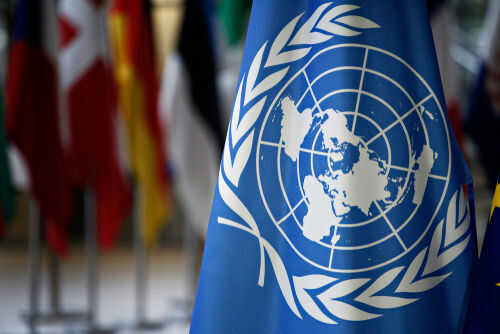
A United Nations-backed shipping plan is laying the groundwork for a de‑facto global tax on trade that American families would feel at the checkout line.
Story Snapshot
- A United Nations shipping agency has designed a carbon pricing scheme that would raise the cost of moving goods worldwide.
- The plan uses a complex fee system on large ships that critics say acts like a global tax on American consumers.
- U.S. officials under President Trump have fought the measure, warning it threatens national sovereignty and higher prices.[6]
- Supporters push it as climate policy, but they have not provided clear numbers on what it means for household budgets.[1][16]
How a UN Shipping Plan Becomes a Tax on Global Trade
The International Maritime Organization, a United Nations agency that regulates global shipping, has pushed a Net-Zero Framework that combines strict fuel rules with direct carbon pricing on ships.[1] The plan targets large ocean-going vessels over 5,000 gross tons, which carry most world trade and produce most shipping emissions. Supporters present this as a clean-energy push, but every dollar added to the cost of moving cargo eventually lands in the price of food, clothes, and household goods.
Under the framework, ships that do not meet new fuel-emission benchmarks must buy so-called “Remedial Units,” which are essentially carbon credits priced around 100 to 380 dollars per ton of emissions.[2] That price sits well above many earlier global carbon tax ideas, which often modeled 40 to 80 dollars per ton.[17] The money would flow into an International Maritime Organization Net-Zero Fund controlled by the same international body. That means an unelected agency in London would skim revenue off the top of world trade and decide how to spend it.[1]
Who Pays: From Cargo Hold to American Shopping Cart
Shipping companies will not absorb these costs out of charity. When the European Union folded shipping into its emissions trading system, studies found that much of the added carbon cost was passed down the supply chain to shippers and customers.[18] The same logic applies here. A cargo ship facing hundreds of dollars per ton in extra climate fees will raise freight rates. Importers then raise prices to retailers, and retailers raise prices for families. The framework’s backers have not released clear, independent modeling of how much grocery and hardware bills would rise.[5][16]
Global institutions such as the International Monetary Fund and the Organisation for Economic Co-operation and Development have pushed for worldwide carbon prices of about 75 dollars per ton or higher by 2030 to drive behavior.[1] United Nations policy papers call carbon taxes a “cornerstone” tool and urge shifting the tax burden “from taxpayers to polluters.”[6] In practice, when fuel costs go up, companies pass them along, so taxpayers still end up paying. The label may say “polluter pays,” but the invoice shows up in the form of higher inflation on everything that moves by sea.
The Sovereignty Fight: Trump’s Team Versus a Global Levy
During earlier rounds of these talks, American officials warned that the International Maritime Organization plan amounted to a global carbon tax on Americans, imposed by an unaccountable international organization.[6][20] They argued that climate policy should be decided by elected lawmakers in Washington, not international negotiators. The United States even refused to agree to adoption of the Net-Zero Framework in 2025, blocking an earlier push to lock it in.[20] That stand forced a delay and exposed how much power unelected bodies were claiming over world commerce.
Reports from those negotiations described U.S. diplomats pushing to tighten adoption rules, so countries would have to explicitly sign on, instead of being swept in by default.[6] That matters because it is the difference between a treaty your representatives must affirm and a rule you are bound by unless you manage to escape. At the same time, think tanks and legal experts warned that once such a scheme exists, pressure builds to expand it beyond ships and into broader trade measures, creating a permanent global revenue stream on cross-border commerce.[17][22]
Follow the Money: Who Benefits from a Global Shipping Levy
Supporters claim the International Maritime Organization Net-Zero Fund would reward cleaner ships, help poor countries adopt new technology, and cushion vulnerable economies.[1] But history with other carbon tax ideas shows that revenue use is one of the most contentious issues.[17] Different papers on maritime carbon taxation stress that where the money goes can shift who gains and who loses, across countries and industries. Critics worry that shipbuilders in nations like China could gain an edge from demand for new “compliant” ships, while American consumers simply pay more.[5]
United Nations guidance for developing countries openly frames carbon taxes as a way to shift the tax base, steer investment, and fund green projects.[6] That may sound appealing in theory, but from a conservative view it hands huge power to global planners to pick winners and losers. Once a central body controls both the rules on fuel and a multi-billion-dollar pot of climate money, the risk of political favoritism and pressure on national policy only grows. That is why many on the right see such schemes as a back door to global economic governance.
What Conservatives Should Watch Next
For American families, the core issues are simple: who sets the rules, who pays the bill, and who controls the money. A global shipping carbon framework would raise the cost of trade, and experience inside Europe shows those costs move down the chain to businesses and households.[18] International reports admit that meaningful climate targets require high carbon prices, not small tweaks, which means serious new pressure on energy-intensive sectors.[1][4] Yet there is still no transparent, peer-reviewed study showing what this would do to the average family’s budget.
As debates continue, conservatives can push for three guardrails. First, no international body should gain taxing power over U.S.-linked trade without approval from elected representatives. Second, any climate rules that touch shipping and trade must come with full, public impact studies on prices, jobs, and supply chains. Third, carbon policy must not be used to smuggle in broader global governance over American energy, industry, or transportation. The fight over shipping is not just about fuel; it is about who runs the world’s economy.
Sources:
[1] Web – UN plan to levy taxes on global trade…
[2] Web – IMO approves net-zero regulations for global shipping
[4] Web – Q&A: How countries got the global ‘net-zero’ shipping deal ‘back on …
[6] Web – International Shipping | Climate Action Tracker
[16] Web – UN reaches deal on global shipping net-zero standard in spite of US …
[17] Web – Impact and motives of Trump opposition to IMO net-zero framework
[18] Web – [PDF] Carbon Pricing in Shipping – International Transport Forum (ITF)
[20] Web – Maritime emissions trading in the EU: Systematic literature review …
[22] Web – State Department Blocks Global Carbon Tax from International …