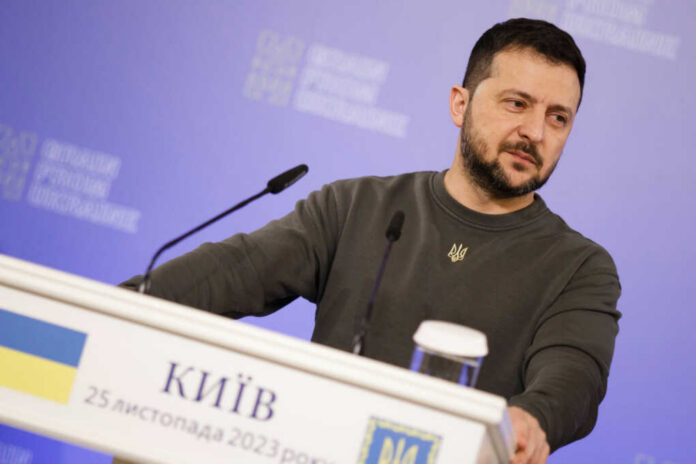
As Washington’s war with Iran strains budgets and priorities, Ukraine is quietly cutting 10-year defense deals with Gulf monarchies that could reshape who supplies air defense—and who gets U.S. attention next.
Story Snapshot
- President Volodymyr Zelensky toured Saudi Arabia, Qatar, and the UAE on March 27–28, 2026, pursuing 10-year defense cooperation pacts focused on air defense and joint production.
- Ukraine is offering combat-tested know-how—especially counter-drone and integrated air defense experience—while seeking advanced air-defense missiles and deeper strategic ties.
- The agreements unfold as the U.S.-Israeli campaign against Iran, launched Feb. 28, enters its second month and Iran’s retaliation drives Gulf demand for drone and missile defense.
- Energy cooperation is part of the talks, reflecting the shock from Iran-related disruptions around the Strait of Hormuz and Ukraine’s own battered energy infrastructure.
Zelensky’s Gulf Tour: 10-Year Pacts Built Around Air Defense and Co-Production
President Volodymyr Zelensky traveled to Saudi Arabia on March 27 and to Qatar and the UAE on March 28 as Ukraine pursued long-term defense cooperation agreements with Gulf states facing Iranian missile and drone threats. Reporting indicates the pacts are structured around joint defense-industry projects, co-production facilities, and technology partnerships rather than one-off arms sales. Zelensky also signaled an emphasis on exchanging scarce resources and battlefield experience, not just hardware.
Qatar’s agreement was described as finalized on March 28, while the UAE component was characterized as pending in the “coming days,” a small but important timing uncertainty in the public reporting. Saudi Arabia’s defense agreement was tied to Zelensky’s March 27 stop. Public details remain limited, and Zelensky did not release full terms, financing, or specific weapons lists, leaving voters and lawmakers in allied capitals with unanswered questions.
Why This Matters During the Iran War: Gulf States Want What Ukraine Learned the Hard Way
Gulf capitals are not shopping for abstract “security cooperation.” Iran’s retaliation has included drones and missiles that pressure regional air defenses, and Ukraine has four years of recent, high-tempo experience countering mass aerial attacks. That experience includes electronic warfare, layered air defense integration, and low-cost counter-drone tactics honed under constant Russian strikes. Zelensky has publicly framed Ukraine’s value as specialists on the ground, not just exported systems.
Zelensky also said Ukraine had already been assisting multiple countries in the region—named in reporting as the UAE, Saudi Arabia, Qatar, Kuwait, and Jordan—in countering Tehran’s drone strikes, including deployment of anti-drone experts. That operational footprint helps explain why the talks moved quickly into decade-long frameworks. The message is straightforward: Ukraine is positioning itself as a provider of defense expertise in real time, not a distant vendor shipping equipment months later.
America’s Strategic Tangle: Resource Diversion, Higher Energy Costs, and Voter Patience Wearing Thin
The timing is politically charged for U.S. conservatives because the Iran campaign is already testing the public’s appetite for prolonged involvement abroad. Zelensky has voiced concern that U.S. resources could be diverted toward the Iran fight, potentially reducing support for Ukraine’s defense needs. Even without new appropriations, finite inventories, air-defense interceptors, and logistics bandwidth become harder to allocate when multiple theaters compete at once.
Energy is the other pressure point. Reporting links these Gulf talks to energy cooperation, with the Strait of Hormuz disruption and broader war risk contributing to volatility that hits American families at the pump and in utility bills. That reality is feeding a familiar frustration among Trump voters: they wanted secure borders, lower inflation, and fewer foreign entanglements—yet they are watching another conflict expand while living costs stay tight and accountability for war aims remains murky.
What’s Known—and What Still Isn’t—About the UAE Pact and the Co-Production Model
Multiple outlets agree the core framework involves co-production and joint manufacturing facilities in both Ukraine and partner countries over a 10-year horizon. Zelensky’s stated preference for co-production over “simple sales” signals a strategic shift: Ukraine aims to trade hard-earned operational knowledge for capabilities it needs, including high-end air-defense missiles Gulf states already possess. Still, public reporting does not specify factory locations, timelines, command relationships, or legal status of deployed specialists.
Ukraine's Zelenskyy signs defense cooperation pacts with three Gulf states https://t.co/rU8IA5xCYa
— Just the News (@JustTheNews) March 29, 2026
The UAE piece remains the biggest near-term question. One report suggested the agreement would be signed soon, while another described discussions that implied the deal might not yet be finalized. That gap matters because it affects how quickly any co-production plans could move from diplomacy to contracts. For Americans watching our own war footing expand, the takeaway is less about Ukraine “winning” or “losing” influence and more about how rapidly new security blocs form when Washington is stretched.
Sources:
Ukraine secures 10-year defense deals with Gulf states amid Iran war
Zelensky visits Gulf Arab states to talk drone defense, seek strategic ties
Zelensky agrees air defence cooperation with UAE, Qatar on Gulf tour