A deadly landslide in communist-run southwest China has buried a village, exposed state failures, and reminded Americans why transparent, accountable government matters.
Story Snapshot
- A massive landslide in Pengshui County, Chongqing killed at least eight people and left 34 missing.
- More than 10 residential buildings were buried and over 1,100 residents were forced to evacuate.
- China’s ruling Communist Party tightly controls all information, limiting independent reporting from the disaster site.
- Heavy rain and weak planning turned a known risk area into a deadly trap for families.
What Happened In Pengshui: A Village Buried In Minutes
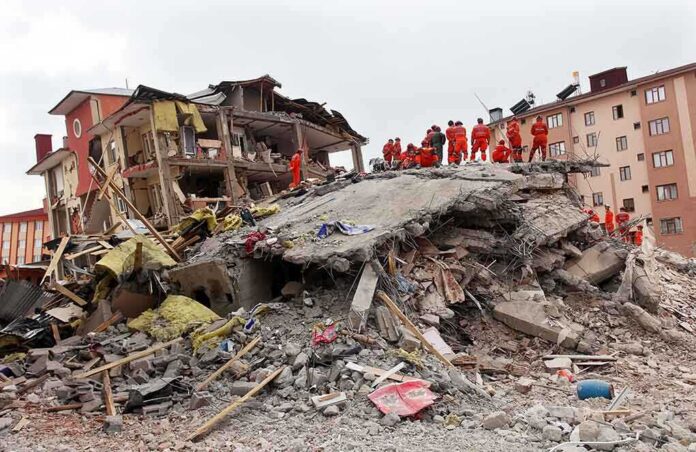
The landslide struck Pengshui County, on the edge of the Chongqing municipality, at about 9:08 a.m. local time on Friday. Massive rocks and soil crashed down a steep slope along the Wujiang River, burying more than 10 residential buildings in seconds. Local officials say at least eight people were killed and 34 remain missing, with rescuers racing the clock and the weather to find survivors under the rubble. Families had little warning and even less protection from poor planning.
Officials report that more than 1,100 residents were evacuated from the area around the collapse site. Some community workers saw scattered falling rocks around 8:00 a.m. and issued an emergency warning, helping move roughly 60 people before the mountainside gave way. Despite that early alert, the landslide hit while the evacuation was still underway, trapping people in homes and on the road below. This timeline raises hard questions about why families were living under such obvious risk in the first place.
Rescue Efforts: Big Numbers, Limited Transparency
China’s Ministry of Emergency Management activated a national Level-II emergency response for geological disasters and sent a 100-member rescue team to Pengshui. State media say more than 800 rescuers have been deployed, including 206 personnel and 49 vehicles from China’s fire and rescue force. Reports from different outlets say nine, then ten, and later 18 people have been rescued, showing how even basic numbers have shifted during the crisis. That inconsistency reflects both the fog of disaster and tight control on information.
As of the latest briefings, authorities say 18 people in total have been pulled from the debris, with eight of them confirmed dead and others treated for injuries. The landslide volume has been estimated at around 18,000 cubic meters of rock and soil, with one giant boulder alone near 3,000 cubic meters in size. That technical data comes from a local planning and natural resources official at a press conference, but there is no public independent geological survey to verify it. In a free system, that kind of independent check would be routine.
State Media Control And Political Framing
Almost every detail the world has about this disaster comes from Chinese state broadcasters like China Central Television and official agencies such as Xinhua News Agency and the Ministry of Emergency Management. There is no sign that foreign journalists or international aid groups have full access to the site, and there is no on-the-ground forensic work published by independent experts. That means the same government responsible for land-use decisions, building approvals, and emergency planning also controls the story of what went wrong.
Chinese President Xi Jinping issued a directive telling officials to carry out “scientific” search and rescue and to investigate the cause of the landslide. On paper, that sounds positive. In practice, such language can give cover for slow or selective release of casualty numbers and findings that protect the regime’s image. Local officials have already framed the area’s terrain as “unpredictable,” with “dangerous rocks still remain,” leaning hard on nature as the villain rather than asking if poor planning put families in harm’s way. That framing matters when the same pattern of rain-triggered landslides has appeared in Chongqing before.
Known Risk: Heavy Rains And Weak Planning
Chongqing is famous for steep hills, fragile slopes, and heavy seasonal rains. Past studies show that landslides in the region often occur when daily rainfall goes above about 250 millimeters, a threshold frequently hit during typhoon season. Earlier this spring, extreme rainfall in Chongqing’s Yongchuan District triggered landslides that killed at least nine people and left 11 missing, with thousands evacuated. Another May 24, 2026 landslide in Yongchuan killed about 20 people after intense downpours. These disasters show a pattern that authorities know well.
#China #landslide kills 8, at least 34 missing: Officials
A landslide in southwest China's #Chongqing killed at least eight people, left 34 missing and triggered a major rescue operation.the site of a landslide along Wujiang river in Pengshui Miao and Tujia Autonomous County, pic.twitter.com/pzzole7r1B— Hans Solo (@thandojo) July 18, 2026
In Pengshui, officials and state media describe the event as “rainfall-induced,” likely linked to days of heavy rain tied to broader storm systems. That label is technically accurate but incomplete. Calling a landslide “natural” does not answer why homes, roads, and even a bus were reportedly positioned in the direct path of a known hazard. For Americans who value local control, honest zoning rules, and real accountability, this tragedy is a reminder that when government hides behind nature and blocks outside scrutiny, ordinary families pay the price.
What This Means For American Readers
This disaster took place far from our shores, but the lessons hit close to home. When a ruling party controls all media, shuts out independent investigators, and treats casualty numbers like political problems, citizens cannot truly know what is happening or hold leaders to account. In the United States, our Constitution, free press, and open records laws are not perfect, but they give us tools that people in Pengshui simply do not have. Those tools matter most in moments of crisis.
For conservative Americans who worry about global elites, government overreach, and growing censorship, Pengshui is a warning. A system that silences outside voices and centralizes power can always find a way to blame “unpredictable terrain” instead of bad planning, wasted money, or corrupt decisions. As we watch grieving families halfway around the world, we are reminded why we fight to keep our own government limited, transparent, and anchored in constitutional rights. Disaster shows the real cost when those safeguards fade.
Sources:
youtube.com, apnews.com, english.www.gov.cn, xinhuanet.com, yahoo.com, newsbreak.com, channelnewsasia.com, globaltimes.cn, global.chinadaily.com.cn, documents1.worldbank.org, bastillepost.com