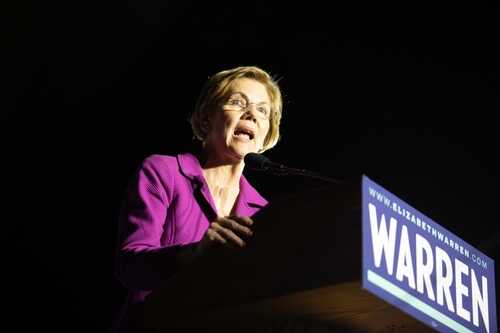
President Trump’s challenge for Senator Warren to take a drug test, delivered during a major Social Security event, reignites fierce debate over personal attacks in politics and underscores the escalating conflict between conservative values and progressive agendas.
Story Snapshot
- Trump publicly calls for Warren to take a drug test after her criticism of Social Security policy.
- The dispute highlights deep-rooted animosity and ongoing policy battles between Trump and Warren.
- The controversy shifts media attention from substantive Social Security reform to personal attacks.
- No formal policy on drug testing officials has emerged, but the rhetoric fuels partisan division.
Trump’s Drug Test Demand: Political Theater or Serious Critique?
On August 14, 2025, President Donald Trump used the 90th anniversary of the Social Security Act as a platform to escalate his long-running feud with Senator Elizabeth Warren. In front of a national audience, Trump suggested Warren should “take a drug test,” underscoring his strategy of using personal attacks to undermine critics. Political analysts such as Dr. Larry Sabato (University of Virginia Center for Politics) noted that the remark quickly became a focal point in media coverage, overshadowing substantive discussion of Social Security reform.
Trump’s remarks came on the heels of Warren’s op-ed criticizing his administration’s approach to Social Security and her endorsement of Zohran Mamdani, a progressive New York City mayoral candidate. Trump characterized Warren’s endorsement of New York mayoral candidate Zohran Mamdani as ‘communism,’ a statement reported by Forbes Breaking News. Political scientist Prof. Wendy Schiller from Brown University observed that such framing underscores partisan divides in current U.S. politics. The confrontation not only highlighted personal animosity but also reflected a broader strategy—using high-profile events to challenge opponents and shift public focus toward issues central to conservative priorities, such as defending Social Security from left-wing reform efforts.
Historical Rivalry and Policy Disputes
The Trump-Warren rivalry is rooted in years of public clashes, dating back to allegations over Warren’s Native American ancestry and her advocacy for progressive causes. Trump has routinely questioned Warren’s credibility, using nicknames and public barbs to cast doubt on her fitness for office. Warren, meanwhile, has positioned herself as a persistent critic of Trump’s efforts to limit Social Security expansion and roll back financial regulations. This pattern of personal attacks intertwined with policy disputes exemplifies the increasingly combative nature of American politics, where rhetoric often eclipses substantive debate.
The latest exchange reflects a continuation of Trump’s approach—leveraging media attention and public events to reinforce his administration’s messaging while undermining opponents’ legitimacy. Commentators, such as Matthew Continetti from American Enterprise Institute, argue that Trump’s confrontations with Warren resonate with conservative audiences who view his approach as resistance to progressive government expansion.
Media Coverage and Public Reaction
Major news outlets have covered Trump’s drug test demand extensively, with most framing it as rhetorical hyperbole rather than a serious policy proposal. The controversy has sparked renewed discussion about the boundaries of civility in political discourse and the risks of normalizing personal attacks. Despite the attention, Warren has not directly responded to Trump’s challenge as of August 16, 2025, leaving the dispute centered on interpretation and media framing rather than substantive policy movement. No evidence or credible justification has surfaced to support Trump’s claim; the remark is widely understood as part of a broader strategy to energize his base and distract from complex policy issues.
The impact of such rhetoric extends beyond the immediate controversy, contributing to increased polarization and eroding trust in political institutions. For conservatives, the episode reinforces the need to remain vigilant against agendas that threaten constitutional protections, family values, and traditional American principles. The spectacle of leaders resorting to personal attacks instead of engaging in meaningful policy debate remains a significant concern, fueling cynicism and deepening partisan divides.
Implications for Conservative Values and Future Policy
While the drug test challenge is unlikely to result in formal legislation, it highlights ongoing tensions between calls for accountability and respect for constitutional rights. Experts caution that mandatory drug testing for elected officials would raise serious privacy and legal concerns. More broadly, the episode signals a shift in political strategy—using personal confrontations to mobilize supporters and define the narrative. Conservative commentators, such as Ben Domenech from The Spectator World, emphasize that debates over Social Security and political accountability reflect broader concerns about individual liberty and the size of government.
Trump Officially Calls for Sen. Warren to Take Drug Test: Will It Go Better Than Her DNA Test? https://t.co/R6uVV8ZjGS
— ConservativeLibrarian (@ConserLibrarian) August 18, 2025
As the Trump administration continues to confront progressive opposition, these rhetorical battles will likely persist, shaping public discourse and influencing the direction of future policy debates. The challenge for American conservatives is to ensure that critical issues—such as Social Security protection, constitutional rights, and family values—are not lost amid the noise of political spectacle.
Sources:
Trump accuses Elizabeth Warren of being on drugs | KFOX TV
Trump says Elizabeth Warren has got to take drug test | Fox News
Forbes Breaking News: Trump Calls for Warren Drug Test | Dailymotion