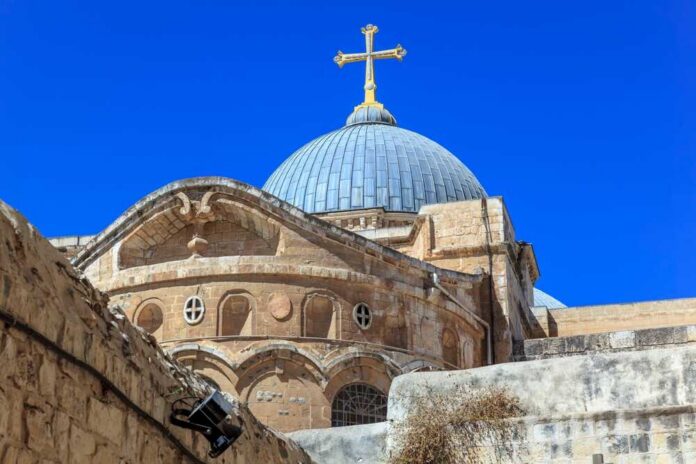
Israeli police stopping a Catholic cardinal from entering Christianity’s holiest church on Palm Sunday is the kind of war-time “security” move that makes ordinary people wonder what rights survive when governments panic.
Quick Take
- Israeli police blocked Cardinal Pierbattista Pizzaballa from entering the Church of the Holy Sepulchre on March 29, 2026, preventing a private Palm Sunday Mass.
- Church leaders said they were traveling without a procession and had already complied with earlier restrictions, but were still turned back.
- The Holy Sepulchre has faced heightened closures and limits since Feb. 28, 2026, after the Israel-U.S. strikes on Iran and the wider war that followed.
- Christian leaders warn the incident sets a “grave precedent” for access to holy sites governed by long-standing agreements.
Police Block Entry to the Holy Sepulchre on Palm Sunday
Israeli police stopped Cardinal Pierbattista Pizzaballa, the Latin Patriarch of Jerusalem, and Father Francesco Ielpo, the Custodian of the Holy Land, from entering the Church of the Holy Sepulchre on March 29, 2026, preventing a Palm Sunday Mass. According to a joint statement referenced in reporting, the clergy were traveling privately and not leading a public procession. Church officials called the denial an unprecedented break with past practice and a serious precedent.
JUST IN: Cardinal Pizzaballa Stopped by Israeli Police and Denied Entry to Church of the Holy Sepulchre in Jerusalem for Palm Sunday Mass – Ambassador Mike Huckabee Condemns “Overreach”https://t.co/Y1YA3TeHGW
— Craig 2.O (@Craig2_O) March 29, 2026
The immediate dispute matters because the Holy Sepulchre is not just another parish church. It is the central shrine tied to the crucifixion and resurrection of Jesus, and it operates under a complex “Status Quo” system governing access and rites among multiple Christian communities. When a government with on-the-ground control can halt even senior clergy from entering for private worship, the practical meaning of religious liberty becomes dependent on shifting security decisions rather than stable rules.
War With Iran Drives Tightened Controls and Cancelled Holy Week Rites
Holy Week 2026 unfolded in a region already on edge, with restrictions escalating after Feb. 28, 2026, when the conflict intensified following Israel-U.S. strikes on Iran. Multiple outlets reported that closures and security measures affected the Holy Sepulchre and broader Old City access. Church leadership had already scaled down public events, including canceling the Palm Sunday procession and postponing the Chrism Mass, shifting toward private prayer and limited observances as officials evaluated conditions day by day.
Cardinal Pizzaballa’s earlier communications emphasized keeping worship alive through prayer while avoiding confrontations with authorities. Plans included alternative liturgical arrangements and calls for a global day of prayer, including a Rosary intention for peace, to unite believers who could not gather safely. The approach reflects a familiar pattern during crises: religious leaders try to respect public order while preserving spiritual continuity. The March 29 incident, however, suggests even that cooperative posture may not guarantee access.
Why the “Status Quo” and Access Rules Matter Beyond Jerusalem
The Holy Sepulchre’s governance is built on historic arrangements meant to prevent power plays and keep fragile peace among Christian custodians. When police action overrides normal access—especially for a private Mass rather than a crowd event—legal and diplomatic questions follow quickly. Church officials described the episode as a “grave precedent,” signaling concern that emergency measures could harden into routine practice. In a war environment, temporary policies can easily become the new baseline without public debate.
What Conservatives in America Are Watching in 2026
American conservatives have spent years warning about government overreach at home, and the same instinct applies abroad when “security” becomes a blank check. With the U.S. now at war with Iran in Trump’s second term, many MAGA voters are split between supporting an ally and rejecting another open-ended conflict that drives up costs and expands state power. This Jerusalem dispute doesn’t prove a coordinated anti-Christian agenda, but it does show how quickly basic freedoms can be curtailed under wartime logic.
Key factual gaps remain because reporting cited Church statements more than Israeli police explanations, leaving the public with limited clarity on the specific operational reason for denying entry that morning. That lack of transparency is its own warning sign: when armed authorities control sacred spaces, rules should be clear, narrow, and accountable. As the Iran war reshapes alliances and priorities, Americans who value constitutional protections should pay attention to any precedent that normalizes restrictions on worship—especially at the very moment faith communities seek peace.
Sources:
Jerusalem Holy Week: conflict, peace, prayer; Cardinal Pizzaballa
Jerusalem Patriarchate cancels Palm Sunday procession, postpones Chrism Mass amid war
Jerusalem patriarchate cancels Palm Sunday procession, postpones Chrism Mass amid war
Cancellation Palm Sunday procession letter patriarch
Israel Prevents Palm Sunday Mass at the Holy Sepulchre for the First Time in Centuries
Palm Sunday procession in Jerusalem cancelled due to war
Cardinal Pizzaballa announces major changes to Holy Week amid war in Jerusalem
Jerusalem’s Palm Sunday procession canceled due to Iran war