
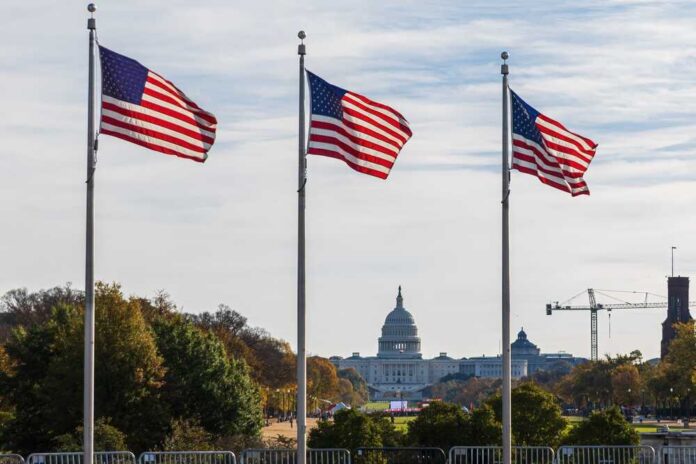
After years of “anti-war” rhetoric, Washington’s loudest Democratic voices suddenly went quiet when real war powers—and the Constitution—were on the line.
Story Snapshot
- U.S. and Israeli strikes against Iran began February 28, 2026, triggering a fast-moving domestic political fight over presidential war authority.
- War Powers efforts to force a withdrawal failed in both chambers in early March, leaving the executive branch largely unchecked.
- Democratic leaders largely focused on process critiques, while activists tied to Robert F. Kennedy Jr.’s 2024 orbit pushed substantive anti-war opposition.
- Polling and protests cited in the research point to broad public resistance to a war with Iran, raising questions about representation and accountability.
Strikes Begin, Then Congress Declines to Rein In the White House
U.S. and Israeli military strikes against Iran started February 28, 2026, setting off an immediate debate over whether the president had constitutional and statutory authority to widen hostilities without a direct vote authorizing war. Within days, Congress faced a clear test: use war powers tools to reassert its Article I role, or allow the executive branch to proceed. The votes that followed signaled institutional reluctance to confront presidential war-making.
On March 5–6, the War Powers Resolution effort failed in both chambers largely along party lines, with reported votes of 53–47 in the Senate and 219–212 in the House. Separately, lawmakers introduced H. Con. Res. 75 on March 4, led by Rep. Josh Gottheimer (D-NJ) with eight Democratic cosponsors, directing the president to remove U.S. armed forces from hostilities against Iran. The legislative push existed, but it did not overcome leadership resistance.
Democrats Split Between “Process” Criticism and Real Opposition
It points to a striking contrast inside the Democratic coalition: party leadership figures criticized procedural issues while avoiding full-throated opposition to the war itself, even as grassroots organizers escalated pressure. That posture matters because the party previously benefited from anti-war messaging during Robert F. Kennedy Jr.’s 2024 campaign, when voters were told the era of “regime change wars” should end and resources should shift back home.
Former Kennedy campaign officials and aligned activists pursued a different strategy—directly opposing the hostilities and framing them as a moral and constitutional problem. “Health Not War!” launched as a petition on March 2 and quickly gathered thousands of signatures. Organizers also treated the petition as a “trial run,” aiming to build a larger political coalition over time rather than merely register symbolic displeasure.
Public Opposition and Street Protests Add Pressure—But Not Votes
Multiple sources cite broad public opposition to war with Iran, including a figure around 70% against it. Demonstrations were reported in cities including Washington, Philadelphia, Baltimore, and Chicago, underscoring that skepticism about another Middle East conflict is not confined to one party or one ideological corner. For many Americans, the practical concern is familiar: open-ended conflict brings unpredictable costs, risk to service members, and pressure on household finances.
Constitutional Stakes: War Powers, Accountability, and “America First” Tension
The constitutional question is the thread tying this story together. Critics describe the action as potentially illegal under U.S. law and the UN Charter, while emphasizing that Congress is supposed to decide when the nation goes to war. From a conservative perspective grounded in limited government, this is not an abstract concern: if lawmakers won’t defend their war powers, the presidency keeps accumulating unilateral authority with fewer checks.
The politics also cut across the Right. It describes internal Republican tension, with “America First” conservatives questioning whether intervention serves U.S. interests and whether foreign-policy influence is distorting decision-making. Meanwhile, outside groups reportedly see opportunity in those divisions, including a referenced ad campaign designed to exploit GOP splits. What is clear is that the institutional system—donors, leadership, and inertia—often outlasts campaign slogans.
Sources:
https://mondoweiss.net/2026/03/its-time-for-america-to-break-up-with-israel/
https://fmep.org/resource/fmep-legislative-round-up-march-6-2026/
https://obrag.org/2026/03/congress-do-your-job-and-end-this-illegal-war-by-the-us-and-israel/
https://www.democracynow.org/2026/3/5/iran_state_defense
https://calmatters.org/newsletter/iran-airstrikes-california-newsom-trump-reaction/
https://truthout.org/articles/what-are-the-trump-administrations-true-objectives-in-iran/