
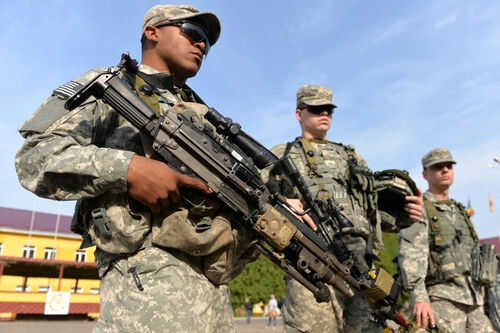
Washington is openly weighing “boots on the ground” in Iran to force open the Strait of Hormuz—an escalation that could jolt gas prices, Congress, and America’s war powers debate all at once.
Quick Take
- President Trump has repeatedly demanded Iran keep the Strait of Hormuz open, pairing diplomatic deadlines with threats of expanded strikes.
- Rep. Pat Fallon said U.S. boots on the ground “may be required,” while other Republicans warned against ground war without clearer authorization.
- Analysts warn the Strait’s geography favors Iran defensively, raising the potential cost and duration of any ground mission.
Trump’s Hormuz Ultimatums Put Ground War Back on the Table
President Donald Trump has framed the Strait of Hormuz as a non-negotiable U.S. interest, issuing public demands that Iran keep the passage open and tying those demands to threats of escalating military action. According to reporting, Trump set deadlines in late March and again in early April, at times claiming negotiations were “productive” while also signaling readiness for broader strikes. The message is clear: if shipping remains threatened, Washington may move beyond airpower.
That pressure matters because the Strait is a global energy choke point, and disruptions show up quickly for American consumers. Reporting cited U.S. gasoline prices at $4.11 per gallon as of April 6, attributed to turmoil connected to the Strait. For conservatives already frustrated by years of high energy costs and policy choices that constrained domestic production, the immediate question becomes whether military escalation would stabilize markets—or compound inflation and uncertainty at home.
Republicans Split Over “Boots on the Ground” and War Powers
Rep. Pat Fallon (R-TX) told Military.com that U.S. ground forces “may be required,” arguing the United States cannot leave “until the job is done.” Other Republicans have urged caution. Rep. Nancy Mace (R-SC) publicly opposed sending troops without congressional approval and fuller briefing, and Rep. Mike Turner (R-OH) expressed skepticism that ground forces would be necessary if Iran’s regime is already weakening under pressure.
The divide highlights a familiar tension inside the GOP: many voters want decisive outcomes overseas while also demanding limited government, constitutional checks, and clear mission definitions. With Republicans controlling Congress, Democrats are still positioned to obstruct through messaging, process fights, and litigation-style oversight, but the more immediate obstacle may be intraparty disagreement about legal authorization, scope, and exit strategy if the military mission shifts from strikes to sustained presence.
Strategic Reality: The Strait’s Geography Favors Iran’s Defense
Military analyst Mick Ryan argues the Strait’s geography creates an asymmetric problem for any U.S. attempt to “secure” the waterway on the ground. His assessment is blunt: the Americans would need to protect a long Iranian shoreline, while Iran needs only threaten a single point to create major disruption. That reality can turn a seemingly narrow objective—keeping shipping lanes open—into an open-ended force protection mission with rising costs.
Ryan also warns that outside actors could exploit a U.S. ground commitment, writing that Russia is already sharing intelligence with Tehran and would welcome chances to help kill American soldiers. Even without a direct Russia-U.S. clash, the risk is that an expanded conflict draws in more regional attacks and escalatory spirals. For an administration focused on “America First,” the strategic challenge is preventing a limited objective from ballooning into a long war.
What’s Known, What’s Speculative, and Why It Matters Now
Still, the real development is straightforward: senior voices are publicly acknowledging that ground forces could be considered if airstrikes fail to achieve core objectives, especially restoring free navigation. For Americans who feel government routinely overpromises and underdelivers—whether on wars, borders, or spending—this moment will likely sharpen scrutiny of mission clarity, congressional accountability, and whether Washington can pursue security goals without repeating past, costly mistakes.
Sources:
Republican Congressman Says US Boots on the Ground May Be Required in Iran
Strikes, Summits, and the Possibility