As China and Russia push warplanes into South Korea’s air defense zone, Americans get a fresh warning about how bold our adversaries have become.
Story Snapshot
- Chinese and Russian military aircraft entered South Korea’s air defense identification zone, forcing Seoul to scramble fighter jets.[2][3]
- The planes stayed for about an hour and avoided sovereign airspace, letting Beijing and Moscow claim the operation was “legal” and routine.[2][3][10]
- South Korea filed a formal protest, calling the unnotified flight a risky move that raises regional tensions and tests allied defenses.[4][10]
- China and Russia insist air defense zones have no legal weight, using this gray area to normalize aggressive patrols near U.S. allies.[11][13]
China and Russia Test the Lines Without Crossing the Border
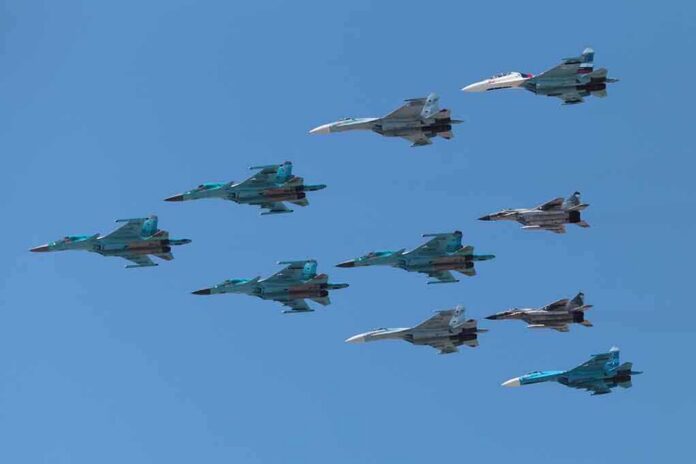
South Korea’s Joint Chiefs of Staff said seven Russian and two Chinese military aircraft entered its Korea Air Defense Identification Zone on December 9, 2025.[2][3] The planes flew over waters east and south of the peninsula for about an hour before leaving.[2][3] South Korea’s Air Force scrambled fighter jets as a precaution, preparing for any accidental clash or fast escalation.[2] Officials stressed that no foreign plane crossed into South Korea’s sovereign airspace, but they also noted the flight was unannounced and risky.[2][10]
Air Defense Identification Zones are bigger than a country’s legal airspace and mainly serve as early-warning buffers.[1][10] Nations use them to demand identification from foreign aircraft to avoid accidents and surprise moves in crowded skies. China and Russia know this, yet they keep sending bombers and other warplanes through these zones without notice, then point to the lack of an actual airspace breach to claim they did nothing wrong.[2][4] That pattern turns a safety tool into a stage for power politics.
Diplomatic Protests vs. Authoritarian Spin
South Korea’s defense ministry lodged a formal complaint with both China and Russia after the incident, saying their planes flew in the zone for an extended period without prior notice.[4][10] Seoul warned that such actions can “unnecessarily heighten tensions in the region” and urged both countries to prevent a repeat.[4] A senior South Korean official said the military will keep actively responding to aircraft operations in the zone under international law, signaling that future incursions will be met with quick fighter scrambles and diplomatic pushback.[4][10]
China and Russia answered with a familiar script. Their defense ministries described the patrols as regular joint strategic exercises carried out above international waters and strictly under international law.[4][6] They also argue that air defense zones are not part of a nation’s sovereign territory and do not carry the same legal weight as actual airspace.[11][13] That line lets them frame the flights as routine training while brushing off South Korea’s complaints as overreaction. Global outlets often repeat this framing and call these drills “annual cooperation,” which downplays the threat and feeds public fatigue.[2][4]
Gray-Zone Pressure on U.S. Allies Is Now Routine
Since 2019, China and Russia have run a growing number of joint air patrols through South Korea’s zone and Japan’s air defense zone.[9][10] These flights follow a set pattern: aircraft enter for 45 to 75 minutes, stay just outside sovereign airspace, and trigger fighter jet scrambles and formal protests that rarely change behavior.[10] By repeating this cycle, Beijing and Moscow turn aggressive moves into normal events. Over time, many analysts start to treat them as background noise instead of serious tests of allied readiness and resolve.[2][4][10]
For American readers, this matters because the same authoritarian partnership that pressures South Korea also targets the United States and our allies in other domains. Research shows China and Russia sharing tools for cyber attacks, running joint disinformation campaigns, and trying to weaken the rules-based order that protects free nations.[19][23][24] Their warplanes near South Korea’s coast and their hackers inside Western networks are two sides of the same strategy: push, probe, and normalize behavior that would once have been seen as unacceptable.
What This Means for U.S. Security and Conservative Priorities
Repeated Chinese and Russian incursions into allied air defense zones highlight the need for strong, reliable defense cooperation among free countries.[2][4][10] South Korea’s quick scramble of fighter jets shows how allies must stay ready every hour of the day, not only during formal crises. For conservatives, this underscores why a focused, well-funded military matters more than trendy agendas, and why America must back partners who are on the front line against authoritarian expansion, not lecture them from afar.[19][24]
These incidents also expose the gap between legal technicalities and real-world security. China and Russia hide behind narrow readings of international law while using gray areas to push their advantage.[11][13][16] A plane that stops one mile short of sovereign airspace can still gather intelligence, test radar responses, and send a political message. When media and global elites treat this as routine, they risk lulling the public into complacency. A sober view recognizes that such “routine” pressure, if ignored, can slowly erode deterrence and invite more dangerous moves later on.[9][19]
Sources:
[1] Web – South Korea says Chinese, Russian military aircraft enter its air …
[2] Web – South Korea scrambles fighter jets as Chinese, Russian … – Reuters
[3] YouTube – Chinese & Russian aircraft enter KADIZ; JCS say airspace not …
[4] Web – Russian, Chinese Bombers Do Joint Patrol Between South Korea …
[6] YouTube – 2 Chinese, 7 Russian Jets Enter South Korea’s Air Defense Zone
[9] Web – South Korea’s Air Force scrambled fighter jets after nine Chinese …
[10] Web – NUMBER OF CHINESE UNAUTHORIZED ADIZ INTRUSIONS … – jstor
[11] Web – China, Russia warplanes enter Korea’s KADIZ; JCS scrambles jets …
[13] Web – [PDF] China’s compliance with selected fields of international law
[16] Web – Joint Declaration of the People’s Republic of China and the Russian …
[19] Web – [PDF] The Rise of China, the United States, and the Limits of …
[23] Web – China Is Hacking Russia to Steal War Secrets – The New York Times
[24] Web – The Cybersecurity Strategies Of China, Russia, North Korea, And Iran