
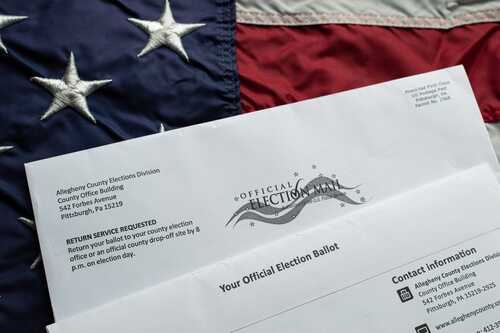
The U.S. Supreme Court’s recent ruling has revolutionized election integrity, giving candidates unprecedented standing to challenge vote-counting rules without proving specific harm.
Story Highlights
- The Supreme Court ruled 7-2 in favor of Rep. Michael Bost and others, allowing them to challenge Illinois’ mail-in ballot policy.
- This ruling establishes a new precedent, enabling candidates to sue over vote-counting rules.
- The decision is a significant win for election integrity advocates concerned about extended mail-in ballot deadlines.
- While celebrated by conservatives, the ruling has sparked concerns over potential litigation floodgates.
Supreme Court Grants New Standing to Candidates
On January 14, 2026, the U.S. Supreme Court delivered a landmark decision in a 7-2 vote, granting candidates like Rep. Michael Bost (R-Ill.) standing to challenge Illinois’ policy of counting mail-in ballots received up to 14 days post-Election Day. This ruling marks a pivotal moment in election law, emphasizing candidates’ inherent interest in election integrity without requiring proof of financial cost or electoral disadvantage.
The ruling diverges from traditional standing requirements, introducing a candidate-specific rule that dismisses the need for showing proven loss risk or financial burdens. This development is particularly relevant for long-shot candidates who wish to uphold election integrity without the burden of demonstrating concrete injury or causation.
Background and Context of the Ruling
Illinois’ provision for counting mail-in ballots postmarked by Election Day but received within 14 days has been a contentious issue, especially among conservatives who argue it dilutes Election Day’s integrity. This policy, challenged by Bost and other Republicans, reflects a broader national debate on mail-in voting rules that expanded during the COVID-19 pandemic. Federal law mandates a uniform Election Day, yet states vary in their receipt deadlines, leading to widespread legal challenges.
The case originated from a 2022 lawsuit filed by Bost and two Trump delegates, which was initially dismissed by lower courts for lack of standing. The Supreme Court’s recent decision overturns these rulings, granting candidates a unique standing to question vote-counting procedures.
Implications and Reactions to the Decision
The Supreme Court’s decision is anticipated to have significant short-term and long-term implications. In the immediate future, it enables Rep. Bost’s challenge on the merits, while prompting Republicans to consider broader lawsuits targeting mail-in ballot deadlines. This decision may also standardize Election Day enforcement, potentially affecting state-level policies.
Politically, this ruling empowers candidates to more aggressively challenge extended counting practices. While conservatives praise the decision for bolstering election integrity claims, there is concern that it could open the floodgates for excessive litigation, complicating the electoral process and potentially disenfranchising mail-in voters.
Supreme Court Upholds Candidate Standing in Ballot Case https://t.co/tkx4uItYg2
— Mojave Red (@SharonGrandmont) January 16, 2026
Experts and commentators have expressed mixed reactions. Chief Justice John Roberts, who authored the majority opinion, emphasized the importance of candidates’ integrity interests. Meanwhile, dissenting voices, including Justice Ketanji Brown Jackson, warn of a potential surge in litigation that could destabilize the electoral system. As this decision sets a new precedent, its impact will likely be felt in upcoming elections and beyond, shaping the future landscape of election law.
Sources:
Supreme Court Vote Counting Ruling
Capitol News Illinois Coverage