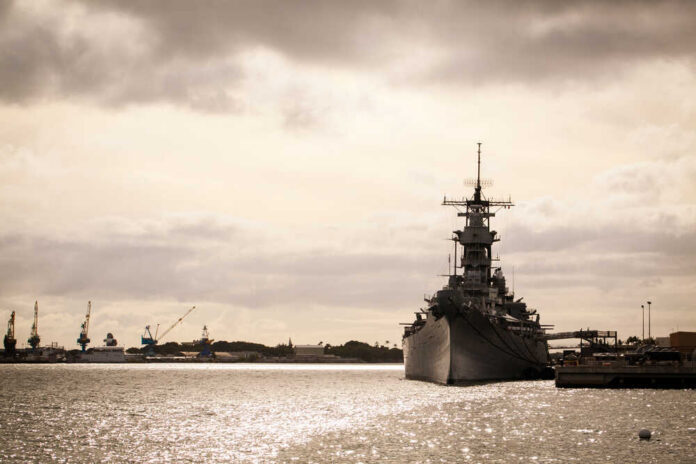
House lawmakers are quietly moving to put a hard brake on President Trump’s new “Golden Fleet” battleships unless the Navy proves every major weapon and technology is truly ready for prime time.
Story Snapshot
- House authorizers want the Navy’s next-generation battleships fully designed and key systems proven before major construction starts.
- Lawmakers cite years of cost overruns and failures on past “leap-ahead” ships and demand “100 percent” design maturity first.
- The Navy argues the new battleships are vital for more firepower, hypersonic weapons, and command-and-control capacity the fleet lacks.
- The fight reflects a broader struggle over how to grow the fleet toward 381+ ships without repeating past boondoggles or exploding the budget.
House Conservatives Move To Slow Risky Battleship Gamble
House Armed Services Committee authorizers are signaling that any new Trump-era battleship program must be tightly gated, with construction tied to hard proof that weapons systems and core technologies are mature, not experimental. That push builds on language already drafted to require the Navy to complete ship designs “100 percent” before starting lead-ship construction, a change driven by “continued frustration” with programs that were not ready for prime time but still moved forward.[2][3] For conservatives tired of Pentagon boondoggles, this is about enforcing discipline, not blocking strength.
President Trump unveiled the “Golden Fleet” battleship concept as a centerpiece of restoring American naval dominance, describing a powerful new class of warships and suggesting the United States could ultimately field 20 to 25 of them, starting with the first two immediately.[1] That framing makes clear this is not a small side project but a massive, long-term industrial and financial commitment. Independent defense analysis estimates such a battleship would take years to design and could cost on the order of $9 billion per ship, with major workforce and yard demands.[2] Those realities are exactly why House authorizers want tighter reins before the nation dives in.
Why Congress Wants ‘100 Percent Design’ Before Cutting Steel
House seapower leaders have spent years watching ambitious ship programs spiral in cost and underperform at sea, and they are using this battleship debate to draw a bright line: no more half-baked designs going into production. A key House amendment would legally force the Navy to have a “100 percent” complete design before building the lead vessel, explicitly closing loopholes the Pentagon used to treat partially designed ships as “complete” and then fix problems later at great expense.[2][3] Lawmakers say they are reacting to repeated “stop-start situations” where incomplete designs produced delays, cost overruns, and weaker fleets instead of deterrence.[2][3] For taxpayers, this is a basic accountability demand: prove the design works on paper and in testing before writing multi-billion-dollar checks.
That insistence tracks with broader expert warnings about the new battleship concept. Analysts at the Center for Strategic and International Studies describe the proposed Trump-class battleship as the world’s largest and most powerful surface combatant, but also as a ship that will “take years to design,” require thousands of skilled shipyard workers the industrial base does not currently have, and clash with the Navy’s own move toward more distributed fleets.[2] Other coverage notes that the Navy itself has been trying to rebuild its “design muscles” for next-generation surface ships, stressing the importance of entering construction with a mature design to avoid past mistakes. House authorizers are essentially taking that logic and codifying it in law, making design maturity a statutory requirement rather than a hopeful talking point.
Navy Pushes Back, Citing Firepower Gaps And China Threat
Senior Navy leaders, while acknowledging past missteps, argue that next-generation battleships are a necessary answer to growing threats, especially from China. Public statements about the Golden Fleet concept emphasize that these large 30,000–40,000‑ton hulls would carry multiple offensive weapons and command-and-control systems the current surface fleet cannot accommodate, including hypersonic missiles, advanced gun systems, directed energy weapons, and critical command-and-control capabilities.[3] The Navy frames the ships as essential to restoring magazine depth and staying lethal in a future high-end fight, not as vanity projects. That argument resonates with conservatives who want overwhelming strength at sea and are wary of the Biden-era drift toward unmanned “science projects” instead of hard power.
At the same time, the Navy’s own long-range plans show how tight the math has become. Nonpartisan analysis of the 2025 shipbuilding plan concludes that reaching a goal of roughly 381 battle force ships, plus 134 large unmanned platforms, would require shipbuilding budgets about 46 percent higher per year in real terms than the recent historical average, with annual costs around $40 billion over 30 years—well above the Navy’s internal estimates.[7][8] Heritage Foundation analysts have similarly argued the nation needs on the order of a 400‑ship Navy to meet global commitments, which adds more pressure to add hulls without bankrupting the country. House conservatives are therefore trying to thread a needle: support Trump’s vision of renewed naval power while demanding that each new program, including the battleship, be grounded in realistic budgets and proven technology.
Lessons From Treaty Limits And Past Battleships
This tug‑of‑war between ambitious warship concepts and political limits is not new. During the interwar period, major naval powers signed treaties that capped battleship size and total tonnage, forcing hard choices between fewer massive ships and more balanced fleets.[7] Historical reviews of those treaty battleships show how quickly costs and displacement balloon when navies chase “maximum” designs, often prompting later retrenchment or cancellations.[5][7] Today’s Congress faces a similar dilemma: how to build large, symbolically powerful ships without repeating history’s mistakes of overconcentration and overspending.
For many conservative voters, the deeper issue is constitutional and cultural: who controls the purse and sets priorities, elected representatives or unelected Pentagon bureaucrats and defense contractors. House authorizers’ move to condition battleship construction on mature, tested technology is ultimately about restoring congressional oversight, protecting taxpayers from runaway programs, and ensuring the Trump administration’s push for naval strength produces real deterrence instead of glossy concepts. If the Navy can prove the Golden Fleet’s weapons and design are ready, these guardrails will clear the way; if not, they may be the only barrier between America and another multibillion-dollar shipbuilding fiasco.
Sources:
[1] YouTube – President Trump Announces “Golden Fleet” Battleships for U.S. Navy
[2] Web – The Golden Fleet’s Battleship Will Never Sail – CSIS
[3] Web – Navy hopes Golden Fleet battleships will solve capacity limits of …
[8] Web – So You Want to Build a Battleship – Construction Part 1 – Naval Gazing