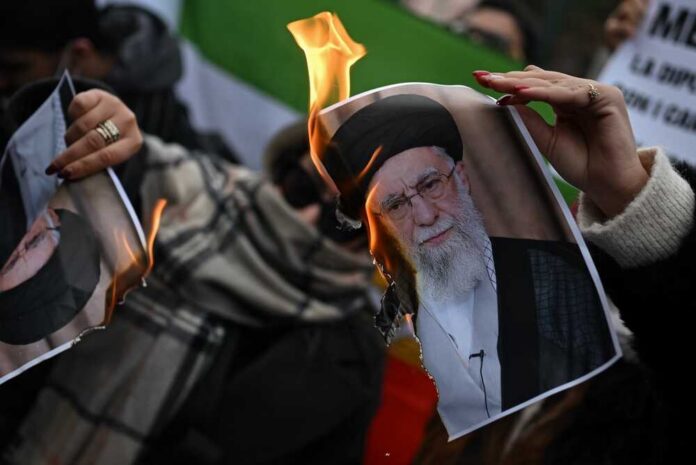
Iran’s next Supreme Leader may be chosen from an already-vetted hardliner pipeline—leaving ordinary Iranians with little say and the West facing a more rigid regime.
Story Snapshot
- Ali Khamenei’s reported February 2026 assassination triggered Iran’s constitutional succession process under an interim leadership arrangement.
- Iran’s Assembly of Experts—an 88-member clerical body—ultimately selects the Supreme Leader, and the field is widely described as hardliner-heavy.
- Reports vary on the interim council’s exact makeup, underscoring “fog of war” limits and why claims of a guaranteed outcome remain unconfirmed.
- Analysts say Iran’s system has long filtered candidates toward ideological continuity, making major reform unlikely regardless of public frustration.
Khamenei’s Death Set Off a High-Stakes, Closed-Door Succession
Iran’s leadership crisis accelerated after reports that Supreme Leader Ali Khamenei was killed February 28, 2026 in airstrikes and that Iran’s Supreme National Security Council confirmed his death the following day. Under Iran’s constitution, an interim mechanism takes over while clerical authorities prepare a selection process. An election date remains unclear in reporting, and even the interim council’s membership is described inconsistently across accounts.
Iran’s system concentrates power in the Supreme Leader, who commands broad authority across security services, the judiciary, and major policy direction. That matters because the succession is not a popular vote; it is decided by the Assembly of Experts, a clerical body whose composition and vetting processes are central to the outcome. In practice, the path to power runs through institutions that have historically excluded challengers to the ruling ideology.
The Assembly of Experts Picks the Leader—But the Candidate Pool Is Narrow
Iran’s Assembly of Experts, described as 88 clerics elected through an indirect process, selects the Supreme Leader. That structure makes the “who” of the Assembly as important as the “who” of the candidates. Reporting and analysis highlighted that Iran’s institutions have tilted toward ideological loyalists for years, which is why outside observers see a hardliner advantage. The current moment amplifies that trend because the country is navigating war pressure and legitimacy problems.
Several names circulate in reporting as possible contenders, including Mojtaba Khamenei, Alireza Arafi, and other senior figures tied to Iran’s clerical and security establishment. Accounts also mention a temporary elevation of Ali Larijani and note that Hassan Khomeini is viewed as unlikely. What remains missing in public view is a definitive, verified shortlist and a clear timetable. With those gaps, claims that any specific individual has already been chosen should be treated cautiously.
Interim Governance and Conflicting Reports Signal Uncertainty, Not Transparency
Multiple summaries describe an interim leadership arrangement tied to Article 111, with varying accounts about which officials are included. Some versions emphasize clerical and judicial figures such as Alireza Arafi and Chief Justice Gholam-Hossein Mohseni-Eje’i, while other reports differ on whether parliamentary speaker Mohammad Bagher Ghalibaf or President Masoud Pezeshkian is part of the interim setup. Those discrepancies do not prove conspiracy; they highlight how difficult verification can be during crisis conditions.
U.S. politics also intersects with the story because President Trump publicly claimed strikes eliminated “most” potential candidates, a statement that has not been confirmed in the provided reporting. Meanwhile, Iranian rhetoric described in coverage includes threats and ideological signaling meant for domestic unity and deterrence abroad. With the leadership transition unresolved, outside governments will likely measure Iran’s actions more than its statements—especially regarding nuclear posture and proxy activity.
Why a Hardliner Successor Could Mean More Confrontation, Not Reform
Analysts cited in the research argue that Khamenei shaped Iran’s institutions to favor ideological continuity, sometimes tolerating limited reformist participation to maintain turnout and legitimacy. That dynamic helps explain why a reformist presence in the interim period does not necessarily translate into reformist power at the top. For conservatives watching from the U.S., the practical takeaway is strategic: Iran’s governing model is designed to resist internal liberalization and external pressure.
Reports: Iran to Elect Hardliner as New Supreme Leader https://t.co/IIlwhr1iWX
— ConservativeLibrarian (@ConserLibrarian) March 4, 2026
Iran’s public faces the most immediate consequences, including political uncertainty, potential unrest, and an economy already strained by isolation and internal control. For the United States, a hardliner-leaning outcome would likely reduce the odds of durable negotiations and increase the chance that deterrence remains the primary tool—especially as leadership legitimacy is tested at home. Limited verified details mean predictions should stay measured, but the system’s structure points toward continuity over change.
Sources:
Khamenei’s Presidential Choice: Weak Reformer or Strong Hardliner
“Death Before Humiliation”: How Iran’s Hardliners Are Framing the Future