
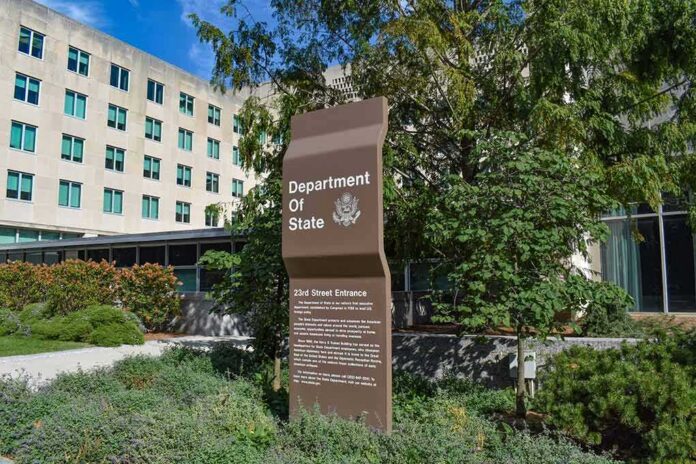
The State Department hired Nate Hochman as a senior aide despite his 2023 firing over a video with Nazi-linked imagery, igniting a fresh test of judgment and standards in federal appointments.
Story Highlights
- The State Department brought on Nate Hochman as a senior aide to the Secretary.
- Hochman was fired from Ron DeSantis’s 2023 campaign after sharing a video featuring a Nazi-associated “sonnenrad.”
- A department spokesman praised Hochman’s work advancing President Trump’s foreign policy agenda.
- The hire spotlights the line between legal political appointments and reputational risk in government staffing.
Who Was Hired And Why It Matters
The State Department hired Nate Hochman in 2026 as a senior aide to the Secretary, placing him inside a high-visibility policy shop. The New York Times reported the move and quoted a department spokesman praising Hochman as a trusted member advancing the President’s foreign policy agenda. The appointment is a political hire, which the government can make based on ideology for such roles, unlike career positions bound by strict merit rules.
Federal oversight reports have long drawn a bright line between political and career hiring. Those reports say political considerations are allowed for political appointees, but barred for career civil servants. That distinction explains how a controversial figure can legally enter a political post while still drawing public scrutiny. The question becomes judgment, not legality, when past conduct triggers broader concerns about fitness and message discipline for sensitive roles.
The 2023 Video And Firing That Sparked The Backlash
In July 2023, Ron DeSantis’s presidential campaign cut ties with Hochman after he promoted an online video that included Nazi-linked imagery. Reporting identified the symbol as the “sonnenrad,” which has been used by Nazi and neo-Nazi groups. The campaign confirmed Hochman’s departure at the time. The episode followed a pattern in modern politics where a single post can end a job, then resurface later when the person re-enters public service.
Major outlets documented the video and the firing, and the clip’s content was not in dispute. The public record focuses on the symbol’s nature and the campaign’s response. Hochman later worked in Republican politics, then moved to the State Department. The new role raises a familiar issue: how far a past messaging error should follow a person, and how a department assures Americans that core values guide its work abroad and at home.
What The Rules Allow And What Voters Expect
Government watchdog guidance states agencies may weigh political beliefs when selecting political appointees, but must use merit for career staff. That means the Hochman hire likely fits within the normal bounds for political staffing. Still, State Department leaders must manage reputational risk that comes with prior extremist-linked imagery. Clear accountability, strong internal standards, and tight message control help prove the agency reflects American principles while executing the President’s agenda.
Supporters of second chances argue performance today matters more than a past online post. Critics argue a senior diplomatic aide must avoid any link to extremist symbols because it weakens moral authority. Both views share a basic point: the stakes are high. The United States leads by example. The department’s spokesman defended Hochman’s contribution to policy goals, signaling confidence in his work while accepting public review of the choice.
Sources:
axios.com, nbcnews.com, miamiherald.com, dissentmagazine.org, bylinetimes.com