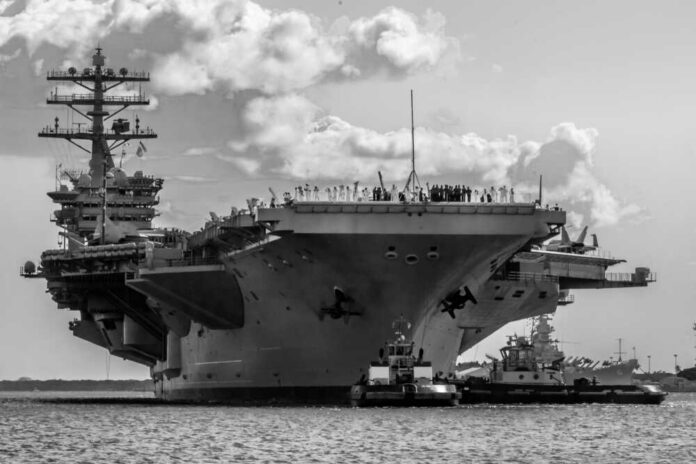
America’s oldest carrier just got a last‑minute life extension to cover for late shipyard work, and it exposes how thin our carrier fleet has been stretched.
Story Highlights
- The Navy extended the **USS Nimitz** to March 2027 to keep 11 carriers in service.
- The **USS John F. Kennedy** Ford‑class carrier is running about two years late.
- Lawmakers’ 11‑carrier mandate is colliding with real‑world shipyard delays and costs.
- Key technical and cost details remain hidden, leaving citizens guessing about readiness.
America’s Carrier Fleet Runs On Old Steel And Legal Mandates
The United States Navy has officially pushed back the retirement of the **USS Nimitz** from May 2026 to March 2027, keeping the 51‑year‑old ship in the fight for about ten extra months. This extension is not a simple choice. It is driven by law. Congress requires the Navy to field at least 11 active aircraft carriers, and without Nimitz, that number would drop until the new **USS John F. Kennedy** is delivered. So instead of a cleaner retirement, the Navy must lean on an aging workhorse for one more year.
The Nimitz extension continues a pattern that defense watchers have seen for years. Navy planners have studied service‑life extensions for Nimitz‑class carriers since at least 2020 to bridge gaps caused by delays in new Ford‑class ships. House Armed Services Committee language in 2018–2019 even pushed the Navy to explore keeping Nimitz past 50 years to avoid losing carrier strength, showing that political pressure has helped stretch these hulls beyond their original design window. In short, “carrier math” has become a juggling act between aging steel, new technology, and congressional rules.
Why Kennedy’s Delay Forces Nimitz To Soldier On
The core reason Nimitz is still sailing is simple: **USS John F. Kennedy**, the second Ford‑class carrier, is late. Breaking Defense reports that Kennedy is now slated for delivery in March 2027, roughly two years behind earlier hopes. Until that ship joins the fleet, dropping Nimitz would break the 11‑carrier minimum that Congress set to protect America’s global reach. Instead of risk that, Navy leaders chose to extend Nimitz and shift her homeport from Bremerton, Washington, to Norfolk, Virginia, for her final stretch of active duty.
This delay is not happening in a vacuum. A 2026 carrier update points to ongoing challenges with advanced weapon elevators and other complex systems on Ford‑class ships. Those issues slow construction and testing, which then ripple out across the whole fleet. The result is today’s crunch: an old carrier that was supposed to start inactivation and defueling this year must keep operating while the newer design finally gets ready. For citizens, it raises serious questions about whether our shipyards and contractors are delivering on time and on budget.
Nimitz’s Final Missions And The Hidden Questions
Despite her age, Nimitz is not just limping along at the pier. The carrier completed a major nine‑month deployment from March to December 2025, covering the United States Central Command and United States Indo‑Pacific Command regions with 8,500 sorties and 17,000 flight hours. Stars and Stripes reports that Nimitz will remain an active warship through March 2027 and is set to deploy to United States Southern Command’s “Southern Seas 2026” mission, training new aviators and showing the flag in the Western Hemisphere. This is real frontline work, not museum duty.
Yet many technical and human details remain out of public view. There is no released forensic report on Nimitz’s nuclear reactor condition or long‑term structural health during this extension. Critics and supporters alike rely on general age concerns rather than hard data. The Navy also has not shared a clear cost‑benefit study comparing the expense of extending Nimitz with the option of accelerating Kennedy’s schedule, even though Congress once demanded such cost estimates when it ordered Nimitz extension options to be studied. Citizens are asked to trust that the math works without seeing the numbers.
Media Spin, Contractor Power, And What Patriots Should Watch
Coverage of this story often frames the situation as proof of a “carrier shortage crisis” or claims that “Navy math is down to a handful,” painting a broad picture of weakness without digging into the legal and budget drivers. That kind of spin feeds public doubt but does not always help readers understand the real tradeoffs: keep an older, proven ship online a bit longer, or accept a hard drop in global reach while waiting on a delayed new hull. The fact that Nimitz’s extension was widely expected because of the 11‑carrier law rarely makes the headlines.
BREAKING NEWS: The 51-year-old USS Nimitz (CVN-68) is celebrating America's 250th birthday as the anchor of the International Naval Review in New York Harbor. Following its final Southern Seas 2026 deployment, the supercarrier's service was extended to March 2027, allowing it to…
— AMC NEWS TRACKER 🇺🇸 🚨🌎🦅 (@AMCTALKTOFOX) July 4, 2026
There are also concerns about **contractor incentives** and **regulatory capture** in this transition. Huntington Ingalls Industries, which runs the Newport News shipyard, benefits from both the advanced planning contract for Nimitz’s inactivation and the roughly $12 billion Ford‑class program. When late delivery of Kennedy forces an extension of Nimitz, taxpayers end up paying to keep the old carrier running while also funding delays on the new one. For conservatives who value strong defense, honest budgets, and limited government, this is a clear signal: watch the carrier numbers, demand transparency on costs and schedules, and insist that our fleet planning serves the Constitution and national security, not just contractors and bureaucrats.
Sources:
19fortyfive.com, navaltoday.com, breakingdefense.com, stripes.com, facebook.com, nationalinterest.org, news.usni.org