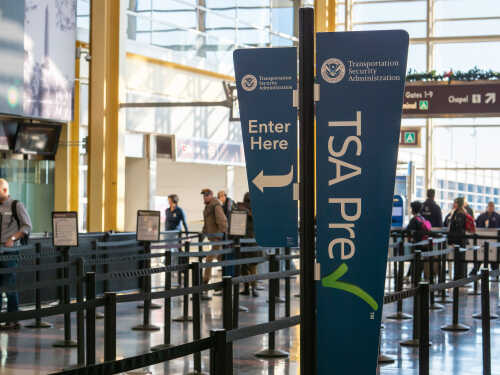
After weeks of shutdown-driven airport chaos, President Trump is signaling he’s ready to put ICE on the front line at U.S. terminals—an escalation Democrats are already calling dangerous.
Quick Take
- Trump said ICE agents would deploy to some U.S. airports starting Monday, March 23, during day 36 of a partial government shutdown tied to DHS funding.
- Long TSA lines and staffing strain have been reported as unpaid workers quit or call out, with wait times described as stretching three hours or more at major airports.
- Trump’s Truth Social message framed the move as both operational support for TSA and an enforcement push to arrest illegal immigrants, including a stated emphasis involving Somalia.
- House Democratic Leader Hakeem Jeffries criticized the plan on television, arguing ICE agents are not trained for TSA screening duties and warning of potential abuse.
Shutdown pressure collides with airport security and enforcement
President Trump’s airport move emerged late March 21 into March 22 as the partial government shutdown—reported to have begun Feb. 14—continued over DHS funding. Reports described TSA staffing stress, including hundreds of quits and widespread call-outs, contributing to delays and long lines at airports such as Houston Hobby, Atlanta, and LaGuardia. The White House message positioned ICE as a near-term stopgap while Congress remains deadlocked on funding.
Trump’s public warning was explicit: if Democrats did not sign an agreement to fund DHS, he would move ICE agents to airports. The stated objectives were twofold—help overburdened checkpoints and arrest undocumented immigrants. That combination matters because it links routine travel operations to immigration enforcement in a highly visible public setting. Supporters see a focus on basic governance—public safety and border enforcement—while opponents argue it risks politicizing airport security.
What the White House said—and what’s still unclear
Border advisor Tom Homan described the airport plan on March 22 as a “work in progress,” indicating details were still being finalized with TSA and ICE leadership. Reporting also indicated the administration was prioritizing large airports experiencing the longest waits. Specific tasks remained uncertain, with possibilities including guarding exits or checking identification, but no definitive, airport-by-airport rollout was publicly confirmed in the available reporting from that weekend.
That lack of specificity is a real limitation for travelers trying to plan and for lawmakers evaluating the legality and practicality of the deployment. Airports are complex security environments with layered federal, local, and private roles. When policy is announced via social media before agencies publish operational guidance, confusion is predictable. From a limited-government perspective, Congress created the funding crisis through stalemate, but Americans should still expect clear rules when armed federal agents enter public transit spaces.
Jeffries’ criticism: “untrained” for TSA work, with brutality concerns
House Democratic Leader Hakeem Jeffries criticized the proposal in interviews, warning that ICE agents are “untrained” for TSA screening and raising concerns about potential brutality. Other Democratic figures and allied groups echoed similar arguments, framing the plan as an overreach and a recipe for more chaos in terminals. The sharp rhetoric, however, does not establish that Jeffries experienced a “meltdown”; the available account describes measured criticism rather than an explosive episode.
Unions representing TSA workers also objected, arguing the deployment does not solve the underlying problem: unpaid employees and deteriorating morale during the shutdown. Their public posture reflects a straightforward operational reality—screening lines depend on trained screeners who show up. If ICE is used primarily for enforcement inside airports, the experience for lawful travelers could become more tense even if it deters illegal travel. The reporting available did not quantify any security improvement from the plan.
The constitutional and governance question beneath the headlines
The most serious policy question is not the political heat; it’s how far the federal government should go in blending airport security functions with immigration enforcement during a funding crisis. The Constitution expects laws to be executed, but it also expects Congress to fund the government it oversees. When Washington fails to do its job, everyday Americans get stuck in lines, and the executive branch is pushed toward improvisation that can expand federal power in public spaces.
Trump Triggers Hakeem Jeffries Meltdown by Naming America’s ‘Greatest Enemy,’ Sending ICE to Airportshttps://t.co/kkXRtkzlOM
— RedState (@RedState) March 22, 2026
On the facts available, the headline claim that Trump “named America’s greatest enemy” is not supported by the cited; what is supported is a Truth Social message referencing Somalia in the context of arrests. Likewise, “meltdown” is a loaded label not substantiated by the documented Jeffries remarks. What is real is the hard-edged standoff over DHS funding, the strain on TSA operations, and a coming test of whether ICE-at-airports is a temporary pressure tactic or a lasting precedent.