
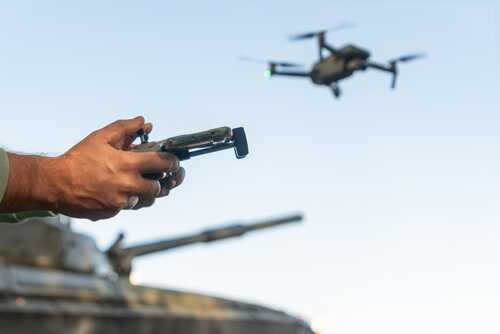
A quiet revolution in warfare now envisions one American soldier directing swarms of AI-driven drones, raising hard questions about who really controls the future battlefield—and whether Washington will guard our values or hand them to the machines.
Story Snapshot
- Defense insiders now openly describe future wars where a single soldier supervises large swarms of AI-enabled drones.
- Real-world conflicts in Ukraine and the Red Sea are serving as testbeds for autonomous and semi-autonomous drone tactics.
- U.S. programs are racing to field hundreds of thousands of low-cost drones, plus AI systems to track and counter swarms.
- Conservatives are right to ask who sets the rules when software—not soldiers—makes split-second life-and-death calls.
From One Rifleman to One Soldier and a Swarm of Machines
For generations, American combat power meant boots on the ground, steel in hand, and a clear chain of command that put a responsible human officer behind every trigger. Today, robotics insiders describe a future where one soldier instead oversees dozens or even hundreds of drones, with artificial intelligence handling most of the navigation, targeting, and coordination. That shift promises radical “force multiplication,” but it also moves lethal power away from individual judgment and toward black-box algorithms.
Developers argue these swarms will operate under “human-on-the-loop” control: a soldier sets broad objectives and rules, while software rapidly detects targets, avoids collisions, and orchestrates attacks. On paper, a single operator could dominate a battlefield sector by unleashing a cloud of expendable drones against enemy armor, artillery, or even ships. That vision, once science fiction, now shapes Pentagon planning and procurement as militaries study how to scale these concepts safely—and how far to push autonomy in lethal decisions.
Ukraine, the Red Sea, and the Live-Fire Labs of Drone Warfare
Wars in Ukraine and the Red Sea have become the proving grounds for this emerging doctrine, with both state and non-state actors deploying cheap drones in massive numbers. Units in Ukraine field first-person-view attack drones, loitering munitions, and surveillance quadcopters, combining them with artillery and electronic warfare to strike armor, trenches, and logistics nodes. In the Red Sea, persistent drone and missile attacks on shipping have forced major navies to respond with far more automated defensive systems than in past conflicts.
These battlefields demonstrate that quantity, networking, and smart software can overwhelm traditional, manned platforms that cost orders of magnitude more. They also reveal the limits of old command structures built on one operator per drone and painstaking manual targeting. As operators struggle with information overload—tracking dozens of blips, feeds, and threats simultaneously—defense planners increasingly see AI as the only way to manage such complexity at scale. That pressure feeds the narrative that a handful of Americans, backed by code, can fight what once took entire battalions.
The Pentagon’s Big Bet on Mass Drones and Counter-Swarm AI
Inside the U.S. system, this vision shows up in large-scale plans to field vast numbers of inexpensive, “attritable” unmanned aircraft alongside the development of AI-powered defenses built to detect, track, and engage swarms. Navy programs are exploring automatic target recognition on helicopters that can follow multiple drones and small vessels at once while feeding a synthesized picture to a supervising human. Defense contractors advertise counter-drone architectures that use AI to fuse radar, electro-optical, and radio-frequency data, then recommend fast responses against complex, multi-direction attacks.
At the same time, broader unmanned initiatives talk openly about procuring hundreds of thousands of drones and dispersing them across the force. That approach fits a world where adversaries like China and Iran can mass cheap unmanned systems to saturate U.S. ships and bases. For a Trump-era Pentagon that wants overwhelming strength without endless troop deployments, swarms promise more firepower with fewer Americans in harm’s way. The risk, however, is building a machine-centered arsenal faster than Congress, the courts, or the public can debate its rules of engagement.
Conservative Concerns: Human Judgment, Mission Creep, and Constitutional Lines
For conservatives who value individual responsibility, constitutional limits, and clear lines of authority, the “one soldier, many drones” concept is a double-edged sword. On one hand, putting robots in front of Americans can save lives, deter hostile regimes, and keep our troops from fighting with outdated gear while adversaries adopt swarms. On the other, pushing lethal decisions into layers of software risks eroding accountability: when split-second choices are made by algorithms, it becomes harder to say exactly who is responsible when something goes wrong.
There is also the danger of technological mission creep at home. The same AI that tracks swarms of enemy drones can track vehicles, boats, or even people, raising concerns about domestic surveillance and government overreach if safeguards fail. If Washington’s permanent bureaucracy and defense industry are eager to automate the battlefield, it falls to elected leaders and vigilant citizens to insist on bright red lines: human beings—not software—must remain clearly in charge of lethal force, and warfighting tools must never be repurposed to monitor or intimidate law-abiding Americans.
Sources:
AI in Warfare: What You Need to Know
Navy seeks AI automatic target recognition and tracking for drones, vessels, helicopters
AI-Powered Counter-UAS: Transforming Drone Defense Strategies
300,000 Drones: What Hegseth’s Drone Build Means and What We Still Need to Know