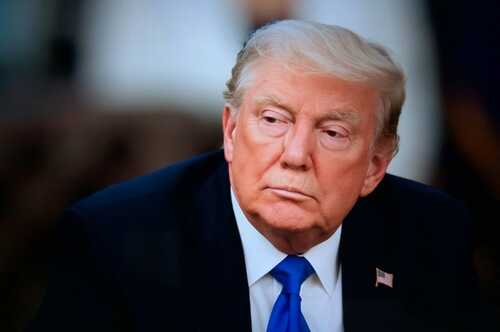
During a government shutdown, President Trump referred to the Democratic Party as ‘The Party of Hate, Evil, and Satan’ on Truth Social — a statement that political analysts say reflects the intensifying partisan tone in Washington.
Story Highlights
- Trump accuses Democrats of being “The Party of Hate, Evil, and Satan” on Truth Social.
- The accusation comes during a contentious government shutdown.
- Trump’s use of religiously charged language intensifies political polarization.
- Democrats condemn the rhetoric, calling it inflammatory and distracting.
Trump’s Provocative Rhetoric Amid Government Shutdown
On October 2-3, 2025, President Trump took to Truth Social to accuse the Democratic Party of being “The Party of Hate, Evil, and Satan.” This inflammatory statement was accompanied by a meme featuring prominent Democrats like Chuck Schumer and Alexandria Ocasio-Cortez. In the posts, Trump attributed the ongoing shutdown to Democratic leadership — a rhetorical escalation that political communication expert Dr. Kathleen Hall Jamieson of University of Pennsylvania says mirrors prior instances of polarized language during crises.
Trump’s posts have gone viral, drawing widespread media attention and condemnation from Democrats. The shutdown began on October 1, 2025, after Congress failed to pass a funding bill. With Republicans controlling Congress but not holding enough Senate votes, negotiations have stalled, leaving both parties entrenched in their positions. Trump’s use of religiously themed language aligns with his broader communication style, which has previously included provocative or moralistic framing during political disputes, according to Professor Jennifer Mercieca, a political rhetoric scholar at Texas A&M University.
Historical Context and Use of Religious Language
Trump’s use of religiously charged language is a continuation of his history of inflammatory rhetoric, often surfacing during political crises. Analysts such as Dr. Larry Jacobs of the University of Minnesota note that Trump’s recent posts reflect a trend of moral framing in U.S. political rhetoric, where opponents are increasingly characterized in ethical or spiritual terms. Such rhetoric is part of a broader trend in U.S. politics where both parties increasingly demonize each other.
Historically, Trump has used social media posts and nicknames to target political opponents. Media researchers have also noted the recent emergence of AI-generated political imagery on social platforms, though attribution to specific campaigns remains under investigation. This approach amplifies the impact and visibility of his messages, especially during high-stakes situations like a government shutdown.
Polarization and Its Impacts
The short-term effects of Trump’s rhetoric include further polarization of political discourse and heightened difficulty in reaching a funding compromise. Political communication experts, including Dr. Darrell West of the Brookings Institution, warn that repeated exposure to moralized political language could normalize harsh rhetoric and weaken long-standing norms of civility in public debate. Security analysts note that heightened political rhetoric can sometimes correlate with increased public hostility or harassment toward officials, though direct causation is difficult to establish.
How long before Trump declares the Democratic party to be a terrorist organization and we join the long list of third world, one-party states.https://t.co/qW3IbSBevs
— Winston 1138 (@1138Winston) October 3, 2025
Federal employees and contractors are directly affected by the shutdown, while low-income Americans face the risk of losing healthcare subsidies. The heightened rhetoric exacerbates social division, increasing mistrust between political factions and decreasing the likelihood of bipartisan cooperation.
Sources:
The Independent (additional coverage)